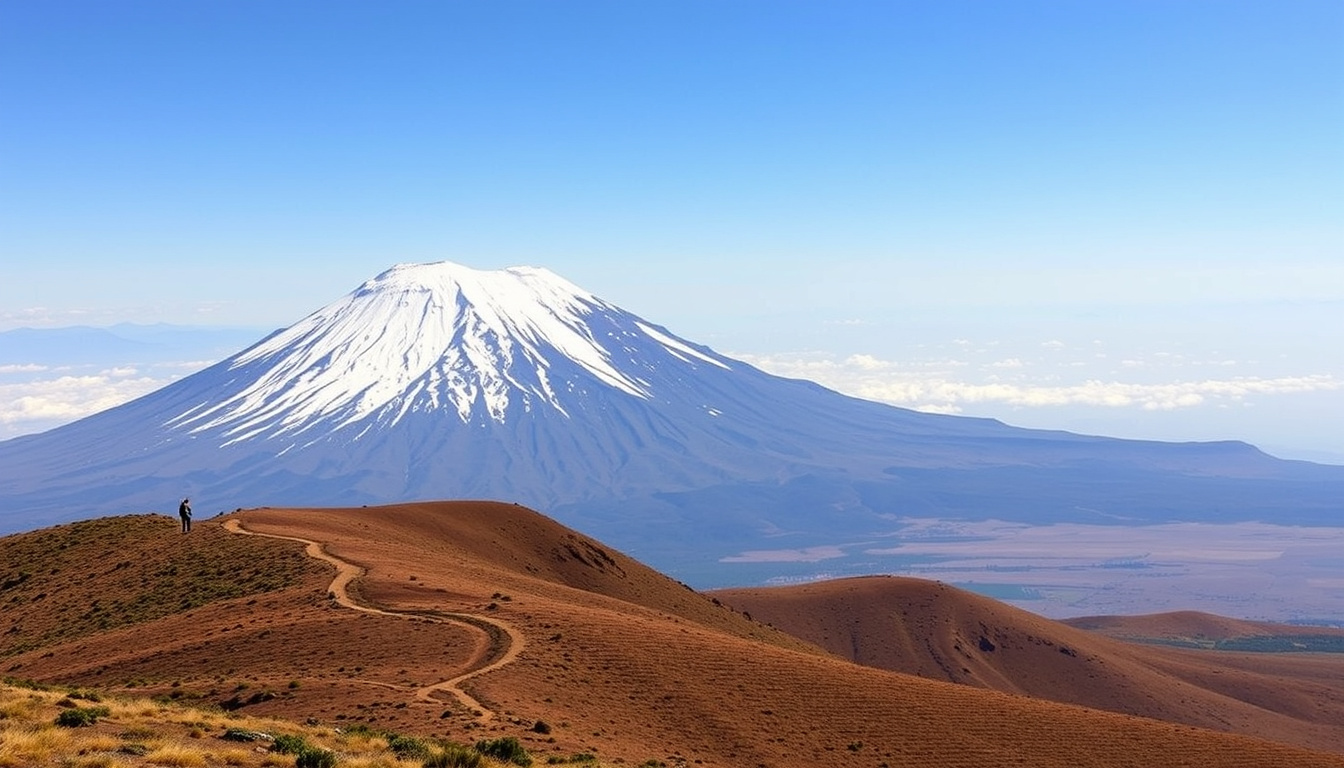
Few experiences match standing on the roof of Africa, and Mount Kilimanjaro is the first high‑altitude trek many consider — a non‑technical climb that doesn’t require ropes or ice axes. But beneath that beginner‑friendly reputation lies a serious altitude challenge that catches many off guard.
Height: 5,895 m (19,341 ft) ·
Location: Tanzania, East Africa ·
Type: Stratovolcano (dormant) ·
First ascent: 1889 ·
Climbing routes: 7 main routes
Quick snapshot
- Uhuru Peak stands at 5,895 m (19,341 ft) (Mawenzi Adventures, a Tanzanian trek operator)
- Kilimanjaro is located in Tanzania (Gorilla Trackers, an East Africa safari specialist)
- It is a non‑technical trek, not a mountaineering expedition (Responsible Travel, a curated tour operator)
- The exact annual death toll is not reliably documented across all routes
- The precise date of the last eruption remains a geological estimate (150,000–200,000 years ago)
- First successful ascent: 1889 by Hans Meyer and Ludwig Purtscheller
- Kilimanjaro has not erupted in the last few hundred thousand years
- Choose a route (Marangu for simplicity, but longer routes boost success)
- Plan a 7‑day itinerary for proper acclimatization
Key facts about the mountain at a glance:
| Attribute | Value |
|---|---|
| Height | 5,895 m (19,341 ft) |
| Country | Tanzania |
| Mountain type | Stratovolcano (dormant) |
| Last eruption | Approximately 150,000–200,000 years ago |
| First ascent | 1889 by Hans Meyer and Ludwig Purtscheller |
| Climbing routes | 7 main routes |
| Summit success rate | ~65% |
| Annual fatalities | 10–15 |
Which is harder, Kilimanjaro or Everest?
Altitude and acclimatization differences
Three key numbers separate the two mountains. Kilimanjaro’s summit sits at 5,895 m (Mawenzi Adventures, a Tanzanian trek operator). Everest’s peak, by contrast, reaches 8,849 m (Britannica, a trusted reference work). The difference matters because the human body starts struggling above 2,500 m, and the “death zone” (above 8,000 m) exists only on Everest. On Kilimanjaro, climbers do not enter the death zone, but they still spend days at altitudes that can trigger severe altitude sickness (Responsible Travel, a curated tour operator).
You trade technical challenge for altitude risk. Everest demands years of training with ropes and crampons; Kilimanjaro demands weeks of pacing and good acclimatization discipline.
Technical difficulty and gear
Everest is a full‑scale mountaineering expedition requiring ice‑axe, crampons, fixed ropes, and years of previous experience. Kilimanjaro is widely described as a non‑technical trek — no ropes, no ice climbing, just a steep walk on rock, scree, and snow (Responsible Travel, a curated tour operator). That distinction makes Kilimanjaro accessible to beginners who have never used a climbing harness (Climbing Kilimanjaro, a commercial guide site).
Success rates and fatalities
Kilimanjaro’s summit success rate hovers around 65%. Everest’s is slightly lower at roughly 60%. But the fatality profiles differ: Kilimanjaro sees an estimated 10–15 deaths per year (a rate of ~0.03% of climbers), while Everest’s death rate is higher per capita, largely due to the death‑zone exposure.
Two mountains, one pattern: the easier climb is still a serious altitude challenge.
| Attribute | Kilimanjaro | Everest |
|---|---|---|
| Height | 5,895 m (19,341 ft) | 8,849 m (29,032 ft) (Britannica, a trusted reference work) |
| Location | Tanzania (Gorilla Trackers, an East Africa safari specialist) | Nepal/Tibet border (Zara Tours, a Tanzanian operator) |
| Technical difficulty | Non‑technical trek (Responsible Travel, a curated tour operator) | Technical climbing (ropes, crampons, fixed lines) |
How many climbers died on Kilimanjaro?
Official fatality statistics
Exact numbers are hard to pin down because records are kept by multiple park authorities and tour operators. Most estimates place the figure at 10–15 deaths per year among the roughly 35,000–50,000 climbers who attempt the summit annually. That works out to a fatality rate of about 0.03% (Responsible Travel, a curated tour operator).
Common causes of death
Altitude‑related illnesses (acute mountain sickness, high‑altitude pulmonary edema, high‑altitude cerebral edema) account for the majority of fatalities. Falls and hypothermia are the other primary causes. Many incidents occur on the descent, when fatigue and lowered guard combine with the drop‑off in oxygen (Mawenzi Adventures, a Tanzanian trek operator).
Comparison with other mountains
The 0.03% rate is extremely low compared with peaks like Denali (0.5%) or Aconcagua (0.15%). It is even lower than the fatality rate on many popular multi‑day hikes in the Himalayas. Still, every death on Kilimanjaro is preventable with proper acclimatization and decision‑making.
Altitude sickness is the leading cause of evacuation even among fit hikers. A 7‑day route instead of a 5‑day route can cut your risk of serious altitude illness by half.
Can a beginner hike Mount Kilimanjaro?
Physical fitness requirements
You do not need to be an athlete. The key is cardiovascular endurance — being able to walk uphill for 5–8 hours a day with a light daypack. Most beginners with a moderate fitness level succeed if they prepare properly (Wilderness Travel, a specialist adventure company).
Recommended training
- Start three months out: hike on varied terrain several times a week.
- Add stair‑climbing sessions to build explosive leg strength and lung capacity.
- Build up to long weekend treks of 6‑8 hours with a loaded daypack.
- Train with the boots you will wear on the mountain — broken‑in footwear prevents blisters (Much Better Adventures, a curated adventure marketplace).
Best routes for beginners
The Marangu Route is the easiest: it has hut accommodations, a relatively gradual ascent, and can be done in 5–6 days. However, a 5‑day Marangu trek gives limited acclimatization time. Operators recommend at least 7 days on any route for first‑timers (Mawenzi Adventures, a Tanzanian trek operator). The Rongai Route is another beginner‑friendly option with low traffic.
Why is Mount Kilimanjaro so famous?
Highest mountain in Africa
At 5,895 m, Kilimanjaro is the tallest peak on the African continent (Wilderness Travel, a specialist adventure company). It is one of the Seven Summits (the highest mountain on each continent) and the only one that a fit beginner can climb without technical gear.
Free‑standing volcano
Unlike most high peaks that are part of a mountain range, Kilimanjaro is a free‑standing stratovolcano that rises from the surrounding savannah. Its base sits at roughly 1,000 ft above sea level (Climbing Kilimanjaro, a commercial guide site), meaning you gain more than 18,000 ft of elevation in just a few days.
Snow‑capped peak near the equator
Kilimanjaro’s glaciers exist just 3° south of the equator — a phenomenon that has fascinated explorers for centuries. The sight of snow on the equator draws photographers, climate scientists, and ordinary travelers alike.
Do you need oxygen for Kilimanjaro?
Altitude on Kilimanjaro
The summit sits at 5,895 m, well into the “very high altitude” zone where oxygen saturation in the blood can drop below 80%. However, because the human body can acclimatize up to about 7,000 m with enough time, most climbers do not use supplemental oxygen (Responsible Travel, a curated tour operator).
Oxygen saturation levels
At base camp (around 2,700 m on most routes), a healthy person’s SpO₂ is typically 92–95%. At the summit it can drop to 70–80%. Portable pulse oximeters are commonly used to monitor levels, and guides watch for symptoms of altitude illness.
When supplemental oxygen is used
On Kilimanjaro, supplementary oxygen is rarely carried. A very small number of commercial operators offer bottled O₂ for clients with pre‑existing conditions, but the standard recommendation is to acclimatize slowly (Mawenzi Adventures, a Tanzanian trek operator). On Everest, by contrast, every climber above Camp IV uses bottled oxygen — a fundamental difference between the two mountains.
Clarity check: what’s confirmed and what remains uncertain
Confirmed facts
- Kilimanjaro’s elevation is 5,895 m (19,341 ft) (Mawenzi Adventures, a Tanzanian trek operator)
- It is located in Tanzania (Gorilla Trackers, an East Africa safari specialist)
- First ascent in 1889
- Most climbers do not need supplemental oxygen
- The Marangu Route is the easiest and shortest (Responsible Travel, a curated tour operator)
What remains unclear
- Exact annual fatality count (estimates range from 10 to 15 per year)
- Precise date of the last eruption (geological consensus: ~150,000–200,000 years ago)
What experienced climbers say about Kilimanjaro
“Kilimanjaro is a tantalising prospect for ordinary hikers — a chance to stand on the roof of Africa without years of mountaineering training.”
— Climbing Kilimanjaro guide site (commercial operator, specialised in the mountain)
“Route choice matters more than fitness on Kilimanjaro. A seven‑day itinerary can double your chances of summitting compared with a five‑day one.”
— Mawenzi Adventures (Tanzanian trekking operator)
“Altitude sickness is the main reason people turn back. It can happen to anyone, regardless of age, gender, or fitness level.”
— Responsible Travel (curated operator with direct guide feedback)
For the would‑be climber, the choice is clear: pick a slow route (at least 7 days), train your legs and lungs, and respect the altitude. Kilimanjaro is not Everest, but it will still push you to your limits. Go prepared, and you will join the 65% who stand on Uhuru Peak. Go unprepared, and the mountain will give you a very expensive lesson in humility. For the first‑time high‑altitude trekkers from the United States, Europe, and Australia, the smart play is a 7‑day Lemosho or Machame route with a well‑reviewed operator — that single decision is your best insurance against turning back short of the summit.
en.wikipedia.org, furtenbachadventures.com, climbing-kilimanjaro.com, reddit.com
Frequently asked questions
What is the best time of year to climb Kilimanjaro?
The dry seasons (January–February and June–October) offer the best weather. July and August are busiest and coldest at the summit.
How much does it cost to climb Kilimanjaro?
Prices range from $1,500 to $5,000 depending on route, operator, and level of service. Park fees alone account for about $700.
What should I pack for a Kilimanjaro climb?
Key items: broken‑in boots, warm layers (base, mid, shell), a good sleeping bag rated to -10°C, trekking poles, water bottles/bladder, and headlamp.
Is Kilimanjaro safe for solo climbers?
Solo climbing is not permitted; all trekkers must go with a licensed guide and at least one porter. Join a group tour if you are travelling alone.
Do I need a guide to climb Kilimanjaro?
Yes. Tanzanian law requires all climbers to be accompanied by a licensed guide. Guide fees are included in all package tours.
What is the success rate for climbing Kilimanjaro?
The overall summit rate is about 65%. Rates are higher on longer itineraries (8‑day routes see 85%+ success) and lower on 5‑day routes (around 50%).
How long does it take to climb Kilimanjaro?
Minimum is 5 days (Marangu), but 7–8 days is strongly recommended for proper acclimatization. The longest standard route is 9 days.
Related stories




Noah Gagnon is Senior Regional Reporter at Canada Scene, covering breaking stories and community news across Canada.