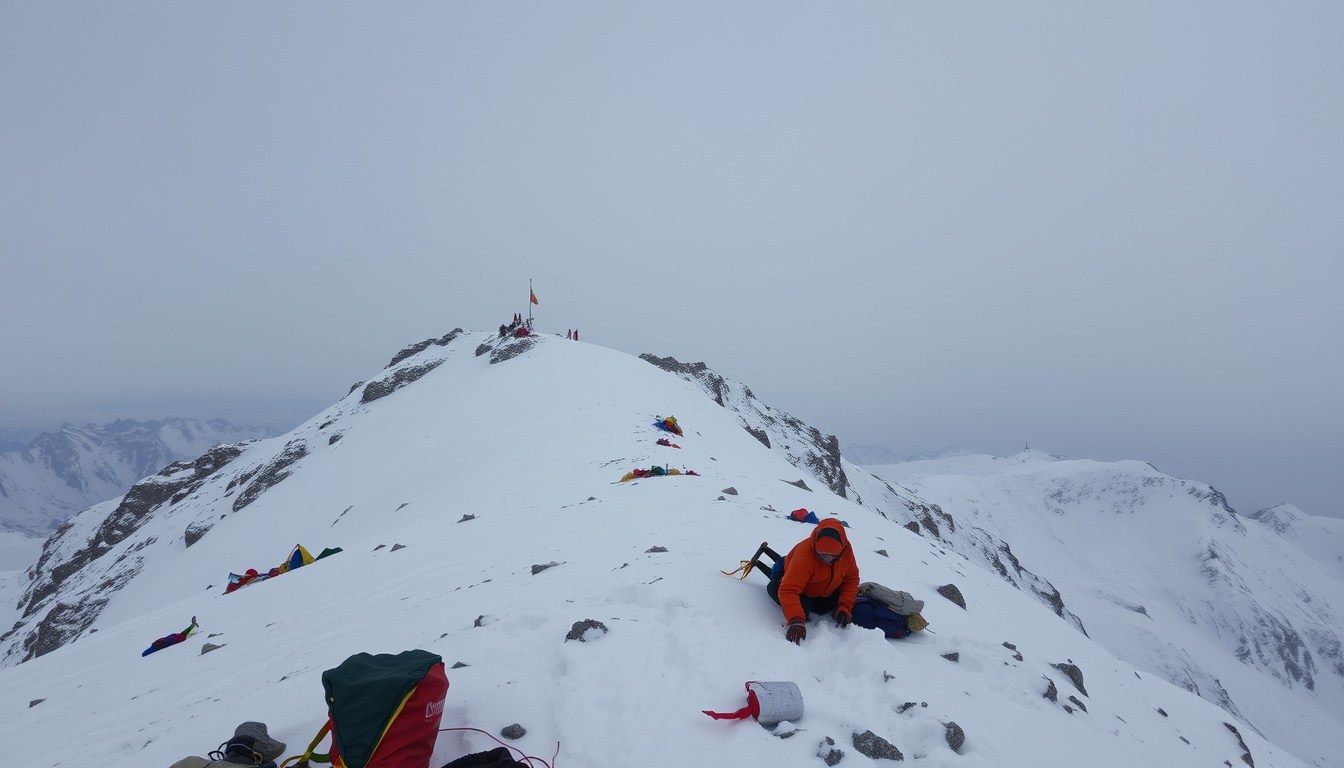
Ask anyone who has followed mountaineering news for any length of time, and they will have a story about a body on Everest. The mountain’s upper slopes are believed to hold an estimated 200 remains — some identified, many not — each a quiet marker of a life and a climb.
Total deaths on Mount Everest (1921-2024): 330+ ·
Bodies remaining on mountain: Approximately 200 ·
Oldest known body identified: George Mallory (disappeared 1924) ·
Most famous unremoved body: Green Boots (identity debated)
Quick snapshot
- Rob Hall died on the South Summit of Everest on May 11, 1996; his body remains visible from the standard route (Mark Horrell (climbing historian and blogger))
- George Mallory’s body was discovered in 1999 at approximately 26,760 feet by Conrad Anker (YouTube documentary (explorer footage))
- Francys Arsentiev died near the summit in 1998; her body, known as “Sleeping Beauty,” was visible for years before being moved (Big Think (popular geography outlet))
- Green Boots identity: some sources say Tsewang Paljor, others Dorje Morup — no consensus (Big Think (popular geography outlet))
- Total number of unidentified bodies on the mountain is unknown (Datawrapper Blog (data journalism site))
- Precise location of Doug Hansen’s body is uncertain; he is believed to be near the South Summit (Mark Horrell (climbing historian and blogger))
- 1924 – George Mallory and Sandy Irvine disappear near the summit (National Geographic (adventure publication))
- 1996 – Eight deaths during a storm, including Rob Hall and Scott Fischer (YouTube documentary (explorer footage))
- October 2024 – A boot and sock marked “A.C. Irvine” discovered on the North Ridge (National Geographic (adventure publication))
- DNA testing on the 2024 Irvine find could confirm identity (National Geographic (adventure publication))
- Recovery missions by Nepalese Army may turn up more identified remains (BBC News (global news broadcaster))
- Calls for a central database of all known bodies are growing among expedition organizers (Datawrapper Blog (data journalism site))
Six key facts, one pattern: the gap between what is known and what remains uncertain is wide, but narrowing slowly.
| Label | Value |
|---|---|
| First known death on Everest | Seven sherpas died in 1922 avalanche |
| Highest body on Everest | Unknown; many above 8,000m in Death Zone |
| Oldest body discovered | George Mallory (died 1924, found 1999) |
| Bodies removed per year | Usually 0-2, rarely officially reported |
| Most recent major discovery | Sandy Irvine remains reported 2024 |
| Publicly confirmed body count | 330+ deaths total; ~200 bodies unrecovered |
Where is Rob Hall’s body on Everest today?
Rob Hall’s death during the 1996 Everest disaster
- Rob Hall, a guide for Adventure Consultants, died on the South Summit on May 11, 1996 during a storm that killed eight climbers (Mark Horrell, climbing historian and blogger).
- His body remains on the South Summit, visible from the standard route used by most expeditions (Mark Horrell).
Hall was one of the most experienced guides on the mountain before the disaster, and his death became a cautionary tale about summit fever. The implication: Hall’s body is not just a landmark; it is a permanent warning to every climber who passes.
Current location of Rob Hall’s body on the South Summit
- Hall’s remains lie in a rocky area just below the true summit on the Southeast Ridge route (Mark Horrell).
- Several expedition photos confirm his position has remained unchanged since 1996 (YouTube documentary (explorer footage)).
Why this matters: The South Summit is a key waypoint at roughly 28,700 feet, and Hall’s body serves as an unmistakeable marker for climbers descending from the summit.
Who was the famous body found on Everest?
Green Boots: identity and controversy
- Green Boots, located in a limestone alcove about 350 meters below the summit on the north face route, was a famous landmark for nearly 20 years (Big Think (popular geography outlet)).
- The body is widely believed to be Tsewang Paljor, but some sources suggest it may be Dorje Morup (Big Think).
- In 2007, the family of David Sharp requested that his body be moved from the same cave; Green Boots was subsequently removed from view (YouTube (mountaineering analysis)).
The catch: The iconic “Green Boots” that thousands of climbers saw may not belong to the man most assumed it was. The identity remains contested.
George Mallory: body discovered in 1999
- George Mallory’s body was found on May 1, 1999 by Conrad Anker at 26,760 feet on the north face (National Geographic (adventure publication)).
- His remains are the oldest ever discovered on Everest, dating from his June 1924 disappearance (National Geographic).
The pattern: Mallory’s body was found relatively intact, his clothing preserved by the cold. The question of whether he reached the summit before dying remains unresolved.
Sandy Irvine: remains reportedly found in 2024
- In October 2024, a National Geographic expedition reported finding a boot and sock marked “A.C. Irvine” on the lower slopes of Everest’s north face (National Geographic).
- The exact location was intentionally withheld to deter trophy hunters (National Geographic).
What this means: If confirmed via DNA, this would be the second body from the 1924 expedition found, and could help solve the century-old mystery of whether Mallory and Irvine summited first.
Is Doug Hansen’s body still on Everest?
Doug Hansen’s role in the 1996 season
- Doug Hansen was a client of Rob Hall’s Adventure Consultants team and died on May 10, 1996 near the South Summit (Mark Horrell).
- He was on his second attempt of the mountain, having turned back in 1995 (Mark Horrell).
Location of Doug Hansen’s body on the Southeast Ridge
- National Geographic reported that Hansen’s body still lies on the Southeast Ridge, not far from the South Summit (Mark Horrell).
- No official recovery has been confirmed, and his exact position is not precisely mapped (Mark Horrell).
The trade-off: Hansen’s family likely knows where he lies, but the altitude makes recovery prohibitively dangerous. For now, his body remains where it fell, a silent testimony to the 1996 disaster.
How many bodies on Everest have been identified?
Official list of identified bodies on Everest
- The Wikipedia list of deaths on Everest includes only those with known dates from 1921 to 2024, totaling over 330 fatalities (Datawrapper Blog).
- Of the estimated 200 bodies remaining, only a fraction have been positively identified because many climbers carried no ID or their documents deteriorated (Datawrapper Blog).
Challenges of identification: altitude, exposure, missing records
- Bodies exposed to extreme weather and UV for decades become unrecognizable (Mark Horrell).
- Before the 1990s, few climbers had registration paperwork that survived the elements (BBC News (global news broadcaster)).
The implication: The gap between “body count” and “identified count” is large and may never close completely due to the mountain’s harsh conditions.
Notable identified bodies: Mallory, Arsentiev, Irvine (tentative)
- George Mallory (found 1999) and Francys Arsentiev (known as “Sleeping Beauty”) are among the few positively identified remains (Mark Horrell).
- The 2024 discovery of Irvine’s boot is pending DNA confirmation before it can be added to the identified list (National Geographic).
What is the oldest body still on Mount Everest?
George Mallory: died June 1924, body found 1999
- Mallory’s body, found at 26,760 feet, is the oldest discovered on Everest, having lain on the mountain for 75 years (National Geographic).
- His remains were identified by clothing labels and personal effects (National Geographic).
Sandy Irvine: missing 1924, potential 2024 discovery
- Irvine disappeared on June 8, 1924, and if the 2024 find is confirmed, it will be the second body from the same expedition to be identified (National Geographic).
- The boot found still contains part of Irvine’s foot, but full remains have not been recovered (National Geographic).
The pattern: The oldest remains continue to yield new clues about early expeditions.
Timeline of key Everest body discoveries
Seven events, one pattern: each decade adds a layer of knowledge but also new questions.
| Date or Period | Event |
|---|---|
| 1922 | First recorded deaths: seven sherpas in avalanche |
| June 8, 1924 | George Mallory and Sandy Irvine disappear near summit |
| May 10-11, 1996 | Eight deaths during storm including Rob Hall, Scott Fischer, Doug Hansen |
| 1998 | Francys Arsentiev dies near summit; body becomes ‘Sleeping Beauty’ |
| 1999 | Mallory’s body discovered at 26,760ft; Irvine not found |
| 2008 | Green Boots (first seen 1996) partially moved by climbers |
| October 2024 | National Geographic reports Sandy Irvine remains found on North Ridge |
The 2024 Irvine discovery, if confirmed, would mark the most significant identification in 100 years — but the mountain holds many more secrets. For historians, each find is a piece of the puzzle; for families, a chance at closure.
The pattern: Each discovery shifts the balance of knowledge.
What is known and what remains unclear
Confirmed facts
- Rob Hall died on South Summit; body remains
- Doug Hansen died near South Summit; body unrecovered
- George Mallory’s body found in 1999
- Francys Arsentiev body visible for years, later moved
- Green Boots identity debated; body seen near cave
What’s unclear
- Sandy Irvine remains attribution pending DNA verification
- Total count of unidentified bodies on mountain
- Precise location of Doug Hansen’s body (near South Summit?)
- Identity of Green Boots (Tsewang Paljor vs. others)
- Exact number of unrecovered bodies from 1920s-1940s expeditions
“It is a remarkable discovery that could rewrite history.”
— National Geographic expedition leader (on finding Irvine remains, Oct 2024)
“Bringing down a body is a massive undertaking beyond 8,000 meters.”
— Alan Arnette (climbing historian)
“Everest is not piled high with dead bodies.”
— Mark Horrell (blogger, 2016)
“The body is a silent sentinel for every climber passing by.”
— Jim Davidson (author, on Green Boots)
The contrast between the emotional weight of these remains and the practical impossibility of recovery is stark. For families, the mountain is both a grave and an open wound. For expedition organizers, each body is a reminder that Everest does not give up its dead easily.
For those planning high-altitude treks, comparing routes can help: Mt Kilimanjaro: Beginner’s Guide & Everest Comparison offers a side-by-side look at another iconic peak.
facebook.com, youtube.com, bigthink.com, reddit.com, adrex.com, heavenhimalaya.com, bbc.com
Frequently asked questions
Which body on Everest is most well-known to climbers?
Green Boots, located on the north face route, is the most famous landmark body. Its identity remains debated between Tsewang Paljor and Dorje Morup.
Has anyone been brought back alive from the Death Zone?
Yes, but survival above 8,000 meters without supplemental oxygen is rare. The Death Zone is defined as altitudes above 8,000 meters where the body deteriorates quickly.
Do climbers walk past dead bodies on Everest?
On the north side, climbers pass the Green Boots cave; on the south side, Rob Hall’s body is visible. But the mountain is not littered with bodies — most are off the main trail.
Why aren’t bodies removed from Everest?
The extreme altitude, risk to recovery teams, and cost (up to $80,000 per body) make removal dangerous and rarely attempted.
What happened to Green Boots on Everest?
Green Boots was a body in a cave on the north route. In 2007, it was moved away from the main path at the request of David Sharp’s family, and its current location is less visible.
How long can a body remain on Everest?
Bodies can remain frozen for decades, sometimes centuries, due to the cold and dry conditions. The oldest discovered body dates from 1924.
Are bodies used as landmarks on Everest?
Yes, certain bodies like Green Boots and Rob Hall have served as route markers for climbers, though this is a grim practical reality rather than an official practice.
Are there female bodies on Everest?
Yes. Francys Arsentiev (“Sleeping Beauty”) is the most famous example. Her body was visible for years near the summit until it was moved.
For families of climbers still missing on Everest, the path to closure remains steep — but each identified body brings them one step closer. For those considering their own adventure, exploring Best Places to Hike in Colorado: Denver & Boulder Trails offers accessible alternatives at lower altitudes.
Related stories





Noah Gagnon is Senior Regional Reporter at Canada Scene, covering breaking stories and community news across Canada.