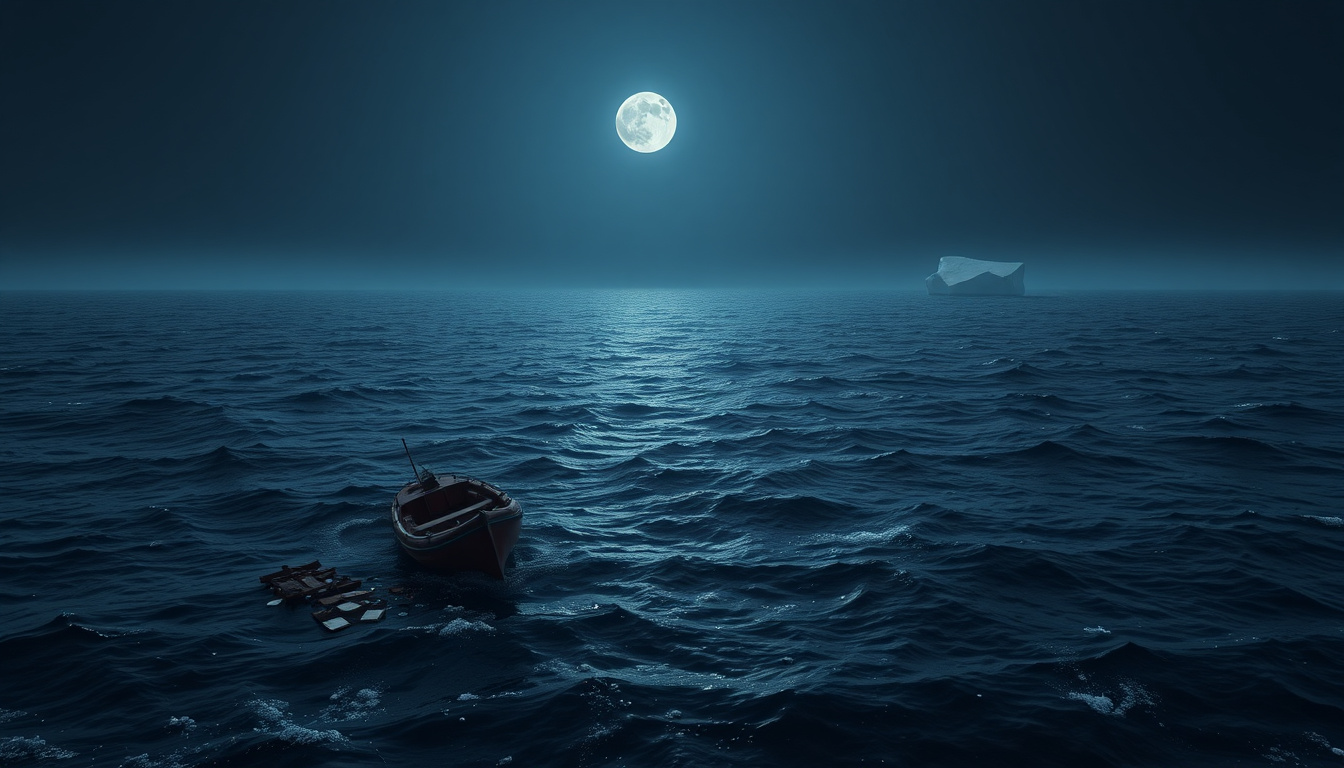
Few moments in history capture the imagination quite like the sinking of the Titanic, and more than a century later people still ask how many survived and who made it. That night in 1912, 705 people out of 2,208 lived to tell the tale — but the difference between survival and death depended far more on ticket class than courage.
Total passengers and crew: 2,208 ·
Survivors: 705 ·
Deaths: 1,503 ·
Passenger survival rate: 37% ·
First-class survival rate: 61% ·
Lifeboats carried: 20
Quick snapshot
- 705 people survived the sinking (Irish Central)
- Highest survival rate in first class (61%) (Bowdoin College History Course)
- Last survivor died in 2009 (Britannica)
- 1,503 people lost their lives (Irish Central) (Britannica)
- Third class suffered the most deaths (Britannica)
- Famous victims include John Jacob Astor and Isidor Straus (Encyclopedia Titanica)
- 20 lifeboats could hold 1,178 people (Wikipedia: Lifeboats of the RMS Titanic)
- Only 705 seats were filled due to confusion and ‘women and children first’ (Bowdoin College History Course) (Wikipedia: Lifeboats of the RMS Titanic)
- Many boats were launched partially filled (Wikipedia: Sinking of the Titanic)
- Found on September 1, 1985 (Britannica)
- 73 years after sinking (Britannica)
- No human remains found inside (Irish Central)
Six numbers capture the scale: 2,208 on board, 705 survivors, 1,503 deaths, 20 lifeboats, last survivor died in 2009, and 73 years to find the wreck.
| Fact | Value |
|---|---|
| Total on board | 2,208 |
| Survivors | 705 |
| Deaths | 1,503 |
| Lifeboats | 20 |
| Last survivor died | 2009 |
| Years to find wreck | 73 |
How many survived the Titanic and how many died?
Total passenger and crew count
The Titanic carried 2,208 people — including passengers and crew — on its maiden voyage from Southampton to New York. According to the Irish Central report referencing British Board of Trade records, 705 survived and 1,503 perished. That means about one in three made it off the ship alive.
A survivor count of 705 is often cited, but some records show 706 due to double-counting discrepancies. The official figure from the British Board of Trade inquiry is 705.
Survivor breakdown by class and gender
Survival rates split sharply by class and gender. First-class passengers had a 62% overall survival rate, second-class 41%, and third-class just 25%, according to analysis by Bowdoin College. Among women, first-class women survived at 97%, second-class at 74%, and third-class at 46%. For men, the rates were 32%, 8%, and 16% respectively. Irish Central notes that men made up 75% of passengers and crew but only a tiny fraction of survivors.
“Women and children first” saved many women, but the policy also meant lifeboats launched half-empty because crew refused to let men board, even when seats remained.
Role of lifeboat capacity
The Titanic carried 20 lifeboats with a total capacity of 1,178 people — barely enough for half of those on board. Wikipedia’s analysis of Titanic’s lifeboats shows that only 18 were launched; two were never deployed. The “women and children first” order from Captain Smith, enforced strictly by Second Officer Lightoller on the port side, led to many boats going down well under capacity. The Bowdoin course notes record that the shortage was the single largest factor in the high death toll.
The implication: the 705 survivors represent not just a number but a measure of how class and protocol shaped who lived and who died. Had all lifeboat seats been used, the survivor count could have been as high as 1,178.
How many kids died in the Titanic?
Number of children on board
Of the 2,208 people on the Titanic, about 109 were children. According to Encyclopedia Titanica, 56 children survived and 53 died — a survival rate of 51%. That means nearly half of the children on board lost their lives.
Child survivors and victims
Children in first class fared best: all five first-class children survived (100%). In second class, 24 of 27 children lived (89%). But in third class, only 27 of 79 children survived — a grim 34% survival rate. Encyclopedia Titanica records that class determined a child’s chance of survival even more sharply than for adults.
Notable child stories
Eva Hart, a 7-year-old second-class passenger, survived but her father perished. She later recalled how her mother had a premonition and refused to sleep in her cabin. The Navratil brothers, Michel and Edmond, aged 3 and 2, survived third class but their father died; they were known as the “Titanic orphans” for weeks. Their mother back in France had no idea they had sailed.
The pattern: children in first class were spared entirely; in third class, two out of three died. Survival for a child was overwhelmingly a matter of ticket price.
What famous people died on the Titanic?
Wealthy industrialists and socialites
The Titanic carried some of the era’s richest figures. John Jacob Astor IV, the wealthiest man on board (worth about $87 million in 1912 — over $2 billion today), died. Encyclopedia Titanica notes that Astor’s body was recovered with $2,400 in his pocket. Isidor Straus, co-owner of Macy’s, refused a place in a lifeboat so that younger men could go; his wife Ida refused to leave him. Both died.
Notable victims
Major Archibald Butt, a military aide to Presidents Taft and Roosevelt, died. Thomas Andrews, the ship’s architect, was last seen in the smoking room staring at a painting as the ship went down. Benjamin Guggenheim, a mining tycoon, dressed in his evening clothes and said, “We are dressed in our best and are prepared to go down like gentlemen.”
Famous survivors
Margaret “Molly” Brown, later known as “the Unsinkable Molly Brown,” helped row lifeboat 6 and urged its crew to return for survivors. J. Bruce Ismay, managing director of the White Star Line, survived by boarding a lifeboat — a decision that ruined his reputation. Britannica records that Ismay faced public scorn for the rest of his life.
“The ship is sinking. The women and children are to go first.”
— Captain E.J. Smith, as recalled by Second Officer Lightoller (Bowdoin College)
The trade-off: the “women and children first” protocol saved many lives among women and children, but it also meant that men of all classes — including the famous and wealthy — were left to die in disproportionate numbers.
Why were no skeletons found on Titanic?
Deep-sea conditions and decomposition
The Titanic lies at a depth of 3,800 meters (12,500 feet) in the North Atlantic. At that depth, conditions are extreme: near-freezing temperatures, immense pressure, and very low oxygen levels. Irish Central explains that these factors prevent the preservation of human remains. Bacteria and scavengers consume organic material rapidly.
In shallower waters, such as the Baltic Sea (where the wreck of the Estonia lies at 80 meters), skeletons have been found because colder, oxygen-poor water slows decomposition. But at Titanic’s depth, the environment is actually more aggressive due to the abundance of wood-boring mollusks and planktonic organisms that consume flesh and bone.
Human bones are made of calcium phosphate, which dissolves in deep-sea water over time. Britannica reports that no human remains have ever been found at the Titanic site. The only traces of the passengers are their belongings — shoes, suitcases, and personal items — that lay scattered on the seafloor.
“We see shoes, but no bodies. The sea has reclaimed them.”
— Robert Ballard, discoverer of the Titanic wreck (Britannica)
The catch: the same deep-sea environment that destroyed bodies preserved the wreck’s structure, creating a haunting and empty museum.
Why did it take 73 years to find the Titanic?
Challenges of deep-sea search
The Titanic’s wreck lies 3,800 meters deep in a vast, dark expanse of the North Atlantic. The ship’s last coordinates were incomplete — the wireless operators had made errors in calculating the CQD distress signal. Early search attempts were limited by technology. Britannica notes that no submarine could reach that depth until the 1960s, and even then, sonar resolution was too coarse.
Technology milestones
In 1985, a joint French-American expedition led by Robert Ballard (Woods Hole Oceanographic Institution) and Jean-Louis Michel (IFREMER) used a towed deep-sea sonar system called Argo. Irish Central reports that Ballard had only 12 days left on his mission when they spotted the wreck’s boilers on September 1, 1985.
The 1985 discovery
The breakthrough came from combining side-scan sonar with underwater cameras. Ballard’s team located the bow and stern 600 meters apart, confirming the ship had broken in two. Brittanica records that the discovery was broadcast worldwide and ended one of the 20th century’s greatest maritime mysteries.
What this means: the 73-year gap wasn’t due to lack of effort — it was a technological limit that was finally broken by determination and a 1980s deep-sea research vessel.
Timeline signal
- April 10, 1912 – Titanic departs Southampton (Britannica)
- April 14–15, 1912 – Titanic strikes iceberg at 11:40 PM; sinks at 2:20 AM (Britannica)
- April 15, 1912 – RMS Carpathia rescues survivors (Britannica)
- September 1, 1985 – Wreck discovered by Robert Ballard and Jean-Louis Michel (Britannica)
- May 31, 2009 – Last survivor Millvina Dean dies (Britannica)
Clarity
Confirmed facts
- 2,208 people on board; 705 survived; 1,503 died (British Board of Trade inquiry, via Irish Central)
- 20 lifeboats carried; capacity 1,178 (Wikipedia)
- No human remains found in the wreck (Britannica)
What’s unclear
- Exact number of survivors sometimes given as 706 due to counting discrepancies
- Fate of some third-class passengers is unknown
- Precise location of the iceberg that sank the Titanic is unknown
Quotes from key figures
“I did not see the iceberg. I heard the collision. The ship was already listing.”
— Eva Hart, survivor (second-class passenger), recalling the night (Encyclopedia Titanica)
“We found the Titanic on September 1, 1985. It was a moment of pure silence.”
— Robert Ballard, oceanographer (Britannica)
“The Board finds that the loss of the Titanic was due to collision with an iceberg, brought about by excessive speed.”
— British Board of Trade, official report, 1912 (Irish Central)
Summary
The Titanic disaster remains a stark lesson in how technology, class, and human judgment intersect. For anyone boarding a ship today, the implication is clear: lifeboat regulations are now tied to passenger capacity, and “women and children first” is no longer official protocol. But the numbers — 705 survivors, 1,503 dead — remind us that class and protocol determined life or death on that April night.
Frequently asked questions
How many first class passengers survived the Titanic?
201 first-class passengers survived out of 325, a 62% survival rate, according to Bowdoin College.
How many crew members survived the Titanic?
214 of the 885 crew members survived, a survival rate of about 24%. Irish Central notes that crew had access to lifeboats but many stayed below decks.
Who was the youngest survivor of the Titanic?
Millvina Dean, who was only 2 months old at the time, was the youngest survivor. She died in 2009 at age 97 (Britannica).
Who was the oldest survivor of the Titanic?
Edith Haisman, aged 79, was one of the oldest survivors. She lived to 100. The oldest male survivor was Edwina Troutt, aged 79 (Encyclopedia Titanica).
How many survivors were rescued by the Carpathia?
The RMS Carpathia rescued 705 survivors from the lifeboats. Britannica confirms that Carpathia arrived about two hours after the Titanic sank.
What is the survival rate for third class passengers?
Only 25% of third-class passengers survived, compared to 62% in first class. Bowdoin College attributes this to the location of third-class berths deep in the ship and limited access to the boat deck.
Are there any visible remains of the Titanic that can be visited?
Yes, the wreck is accessible via deep-sea submersibles. Tour operators like OceanGate Expeditions (now defunct) offered visits. The wreck is deteriorating, and the crow’s nest collapsed in 2019 (Britannica).
Related stories




Kevin Sullivan covers community events, neighbourhoods and local culture from coast to coast.