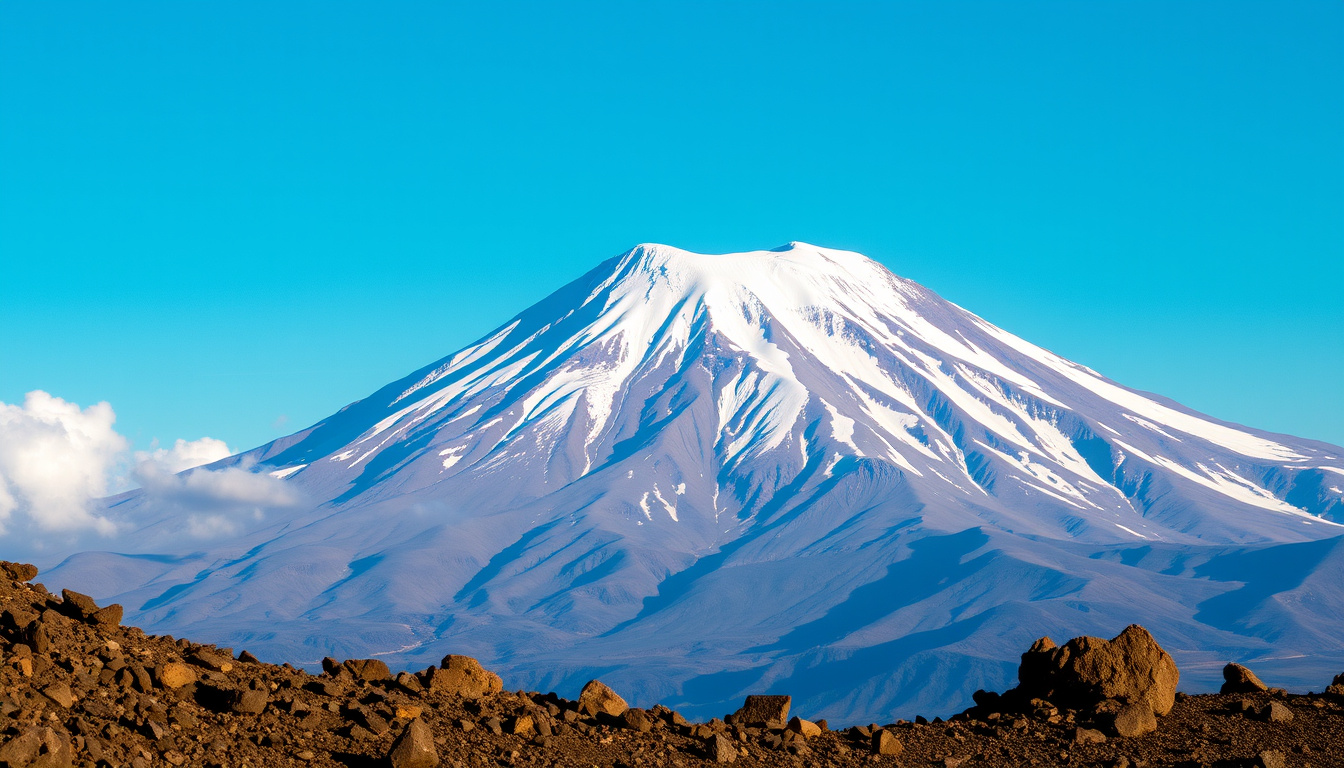
Few mountains capture the imagination like Mount Kilimanjaro – a snowy peak on the equator, rising alone above the African plains. It’s the world’s tallest free-standing mountain, and for many, it represents the ultimate adventure without needing ropes or crampons.
Height: 5,895 m (19,341 ft) ·
Location: Tanzania, East Africa ·
First Ascent: 1889 ·
Last Eruption: Approximately 360,000 years ago ·
Climbing Routes: 7 ·
Annual Climbers: ~35,000
Quick snapshot
- Height: 5,895 m (19,341 ft) – official measurement (Responsible Travel)
- First ascent: 1889 by Hans Meyer and Ludwig Purtscheller (Kiriwe Travel & Safaris)
- Last eruption: ~360,000 years ago (National Geographic)
- Exact annual death count – park data vs. media reports vary (Xpats International)
- Future of glacial ice – rate of melting uncertain (National Geographic)
- Success rate depends on route, season, and operator (Altezza Travel)
- 1889: First recorded ascent (Kiriwe Travel & Safaris)
- 1973: Kilimanjaro National Park established (Responsible Travel)
- 1987: UNESCO World Heritage site (National Geographic)
- 2000s: Surge in eco-tourism (Ian Taylor Trekking)
- Continued glacier retreat expected (National Geographic)
- Growing popularity of longer itineraries (8-9 days) to boost success rates (EverTrek)
- Regulatory changes in permit systems and guide requirements (Responsible Travel)
Nine key facts about Mount Kilimanjaro, one pattern: the elevation and success rate stand out as the most actionable data for anyone planning a climb.
| Attribute | Value |
|---|---|
| Elevation | 5,895 m (19,341 ft) |
| Location | Tanzania, East Africa |
| First Ascent | 1889 by Hans Meyer and Ludwig Purtscheller |
| Last Eruption | Approximately 360,000 years ago |
| Number of Routes | 7 (Marangu, Machame, Lemosho, Rongai, Umbwe, Shira, Northern Circuit) |
| Average Climb Duration | 6-9 days |
| Success Rate | ~65% overall (~85% on 8-9 day routes) |
| Annual Climbers | ~35,000 |
| Fatalities per Year | Estimated 10-15 |
Why is Mount Kilimanjaro so famous?
What makes Kilimanjaro unique?
- It is the highest free-standing mountain in the world, rising 5,895 m from the plains of Tanzania (Responsible Travel).
- It is the highest mountain in Africa, earning it the title “Roof of Africa” (National Geographic).
- Its iconic snow cap, now rapidly vanishing, has been a symbol of the continent for centuries (National Geographic).
The implication: Kilimanjaro’s fame rests on two pillars – its sheer vertical rise and its accessibility to ordinary trekkers. No other peak offers that combination.
Historical significance
- First ascent in 1889 by German geographer Hans Meyer and Austrian mountaineer Ludwig Purtscheller (Kiriwe Travel & Safaris).
- Kilimanjaro National Park was established in 1973 (Responsible Travel).
- Designated a UNESCO World Heritage site in 1987 (National Geographic).
Because Kilimanjaro is a non-technical walk-up, it became one of the first high-altitude peaks to attract mass tourism. That accessibility, paired with the UNESCO designation, turned a volcanic cone into a global bucket-list destination.
Cultural importance
- Kilimanjaro is a major economic driver for Tanzania, attracting ~35,000 climbers annually (Altezza Travel).
- It features prominently in literature, film, and even Ernest Hemingway’s short story “The Snows of Kilimanjaro” (National Geographic).
Why this matters: Kilimanjaro is not just a mountain – it’s an icon that represents human endurance and the fragility of high-altitude ecosystems. Its cultural weight influences everything from tourism policy to conservation funding.
Can a beginner climb Kilimanjaro?
Physical fitness requirements
- Kilimanjaro is a non-technical hike – no ropes, harnesses, or climbing experience needed (Responsible Travel).
- Difficulty is rated as a strenuous trek, not mountaineering (EverTrek).
- A reasonable fitness benchmark: able to run 5 km and hike 10 km in a day (Altezza Travel).
The catch: altitude sickness is the main challenge, not the terrain. Most beginners underestimate the effects of sleeping at 4,000 m.
Training tips
- Minimum recommended preparation: 6-8 months of cardio and hiking with a loaded pack (EverTrek).
- Focus on building leg strength, lung capacity, and endurance for 6-9 days of consecutive hiking (Ian Taylor Trekking).
Choosing a route
- Seven official routes vary from 5 to 9 days; longer trips have higher success rates (EverTrek).
- Marangu is the only route with dorm-style huts, but it offers limited acclimatization time (Responsible Travel).
- Machame (a camping route) is more scenic and allows better gradual altitude gain (Alpine Ascents).
Acclimatization
- The key principle is “climb high, sleep low” – ascend to a higher altitude during the day but return to a lower camp at night (Altezza Travel).
- Itineraries of 7-8 days significantly improve acclimatization and reduce Acute Mountain Sickness risk (Altezza Travel).
- Success on Kilimanjaro depends more on acclimatization than hiking skill (Altezza Travel).
The pattern: a beginner can safely reach the summit if they pick a long enough route and train for altitude, not just stamina. Routing decisions are the single biggest controllable factor.
Do you need oxygen to climb Kilimanjaro?
Altitude and oxygen levels
- The summit at 5,895 m lies above 8,000 ft but below the “death zone” (8,000 m) where supplementary oxygen becomes critical (Xpats International).
- At the summit, air pressure is about half of sea level, meaning significantly less oxygen per breath (Responsible Travel).
Do climbers use supplemental oxygen?
- Most climbers do NOT use bottled oxygen on Kilimanjaro (Altezza Travel).
- Proper acclimatization through the climb-high-sleep-low method is the standard approach (EverTrek).
- Risks of HACE and HAPE (high-altitude cerebral and pulmonary edema) exist but are manageable with slow ascent and descent protocols (Alpine Ascents).
Comparison with Everest
- Everest’s summit at 8,848 m sits in the death zone; bottled oxygen is standard above 8,000 m (Xpats International).
- Kilimanjaro does not require oxygen because its highest camp is at ~4,600 m, and the summit push from that altitude is roughly 1,300 m – achievable without supplementary oxygen (Roaming Nanny).
The trade-off: skipping bottled oxygen means you must respect the altitude. Slow itineraries give your body time to adapt; fast itineraries are riskier. For most beginners, an 8-day route with no O₂ is safer than a 5-day route with it.
What is harder, Everest or Kilimanjaro?
Technical difficulty
- Everest is extremely technical – ice, rock, crevasses, fixed ropes, and ladder crossings (Xpats International).
- Kilimanjaro is a walk-up – no technical equipment needed (Responsible Travel).
Altitude and oxygen
- Everest summit altitude: 8,848 m; Kilimanjaro summit: 5,895 m (Xpats International).
- Everest requires bottled oxygen above the death zone; Kilimanjaro does not (Roaming Nanny).
Duration and preparation
- Kilimanjaro climbs typically last 5-9 days; Everest expeditions take 2+ months (Ian Taylor Trekking).
- Everest Base Camp trek (not the summit) is also longer than a typical Kilimanjaro climb (Ian Taylor Trekking).
Fatality rates
- Everest fatality rate ~1-2% (Xpats International).
- Kilimanjaro fatality rate ~0.1% (estimated 10-15 deaths among ~35,000 climbers per year) (Xpats International).
Eight differences, one pattern: the comparison breaks down into technical demand versus altitude strain. For a beginner wanting a high-altitude challenge without technical climbing, Kilimanjaro is the clear choice.
Here’s a direct comparison table summarizing the key differences:
| Aspect | Mount Kilimanjaro | Mount Everest |
|---|---|---|
| Summit elevation | 5,895 m (19,341 ft) | 8,848 m (29,032 ft) |
| Technical difficulty | Non-technical trek | Extreme ice/rock climbing |
| Bottled oxygen needed | No | Standard above 8,000 m |
| Duration | 5-9 days | 2+ months |
| Approximate cost | $2,000 – $6,000 | $30,000 – $100,000 |
| Fatality rate | ~0.1% | ~1-2% |
The implication: Everest is a mountaineering expedition; Kilimanjaro is an endurance trek. The two share only the word “mountain.” Beginners who dream of Everest should start on Kilimanjaro – it’s the safer, cheaper, and more achievable first step.
How many climbers died in Kilimanjaro?
Historical fatality statistics
- Estimated 10-15 deaths per year based on park records and media reports (Xpats International).
- Fatality rate is roughly 0.03-0.04% of annual climbers (Xpats International).
- Most fatalities occur on summit day or during descent (Alpine Ascents).
Main causes of death
- Altitude sickness (HACE/HAPE) is the leading cause (Alpine Ascents).
- Falls, hypothermia, and Acute Mountain Sickness also contribute (Responsible Travel).
Comparison with other mountains
- Kilimanjaro’s fatality rate is much lower than peaks like Everest (1-2%) or Aconcagua (Xpats International).
- Even relative to other trekking peaks (e.g., Mont Blanc), Kilimanjaro’s death toll is modest (Roaming Nanny).
Safety measures
- Guided climbs with licensed operators reduce risk significantly (Responsible Travel).
- Proper acclimatization (longer routes) and early descent protocols for AMS symptoms are critical (EverTrek).
- The park requires all climbers to be accompanied by a licensed guide (National Geographic).
The 10-15 annual deaths are not from the climb itself but from altitude misjudgment. Most victims were on short itineraries (5-6 days) and descended too late. For beginners, the real risk is not falling – it’s ignoring symptoms.
The pattern: fatality rates are low but preventable. Longer itineraries and guided climbs are the strongest safety factors.
Steps to Prepare for Your Kilimanjaro Climb
- Choose your route wisely
- Select a 7-9 day route (Machame, Lemosho, or Northern Circuit) to maximize acclimatization (EverTrek).
- Avoid the 5-day Marangu route for a first climb – too little time to adapt (Alpine Ascents).
- Train with purpose
- Begin 6-8 months before your climb: focus on hill walking with a loaded pack, stair climbing, and cardiovascular endurance (Altezza Travel).
- Aim to be comfortable hiking 10-15 km daily with a 5-10 kg pack (EverTrek).
- Book with a reputable operator
- Use a licensed operator registered with Kilimanjaro National Park (Responsible Travel).
- Look for established companies with high-altitude guides and emergency oxygen kits (Alpine Ascents).
- Pack for altitude, not just weather
- Layered clothing, a sleeping bag rated to at least -10°C, and a water filtration system (Responsible Travel).
- Essential medications: acetazolamide (Diamox) for altitude prevention, and NSAIDs for headache (EverTrek).
- Follow the golden rule – listen to your body
- If you experience persistent headache, nausea, or loss of coordination, descend immediately (Alpine Ascents).
- No summit is worth permanent brain damage or death (Xpats International).
The trade-off: longer itineraries cost more in time and money, but they dramatically increase your chance of reaching the summit safely. Skipping steps to save a few hundred dollars is the single biggest mistake beginners make.
Clarity: What’s confirmed, what’s not
Confirmed facts
- Height: 5,895 m (19,341 ft) – official measurement (Responsible Travel)
- Location: Tanzania, East Africa (Responsible Travel)
- First ascent: 1889 (Kiriwe Travel & Safaris)
- Last eruption: ~360,000 years ago (National Geographic)
- Number of routes: 7 (Alpine Ascents)
What’s unclear
- Exact annual death count – park data vs. media reports vary (Xpats International)
- Future of glacial ice – rate of melting uncertain (National Geographic)
- Success rate – depends heavily on route, season, and operator (Altezza Travel)
- Whether Kilimanjaro is physically harder or easier than Everest Base Camp – conflicting guide opinions (Roaming Nanny; Xpats International)
- Exact length and status of the Northern Circuit route – described as the longest but sources differ (Kiriwe Travel & Safaris)
The implication: the facts you can rely on are the mountain’s height, location, and history. Anything about death counts or success rates should be treated as estimates.
Quotes from the mountain
Kilimanjaro is a tantalising prospect for ordinary hikers – a snow-capped peak on the equator that doesn’t require mountaineering skills.
— National Geographic (National Geographic (editorial authority))
The difference between a successful climb and a failed one is almost always about how well you’ve prepared for the altitude, not the trail.
— Climbing guide, Ian Taylor Trekking (Ian Taylor Trekking (climbing guide))
The paradox: Kilimanjaro is simultaneously the world’s easiest high-altitude summit and its most deceptive. The walk-up trails hide an altitude profile that has sent hundreds of unprepared trekkers home disappointed – or worse, to the hospital.
For the beginner dreaming of standing on the Roof of Africa, the choice is clear: invest in a longer itinerary, train your legs and lungs, and listen to your guide – or risk becoming another statistic on a mountain that doesn’t forgive shortcuts.
For a deeper dive into route comparisons and training plans, check out our Mt Kilimanjaro: Beginner’s Guide & Everest Comparison.
Related reading: Mt Kilimanjaro: Beginner’s Guide & Everest Comparison
kilimanjaropark.org, wildernesstravel.com, facebook.com, alpineascents.com
Frequently asked questions
What is the best route for a beginner on Kilimanjaro?
The Machame or Lemosho routes are recommended for beginners due to their gradual altitude gain and scenic variety. The Marangu route is easier terrain but has lower success rates because of its shorter acclimatization period. (Responsible Travel)
How much does it cost to climb Kilimanjaro?
Expect to pay between $2,000 and $6,000 for a guided climb, depending on route, duration, and operator. Budget operators may cut corners on safety gear and permits. (EverTrek)
What gear do I need for a Kilimanjaro climb?
A sleeping bag rated to -10°C, layered clothing, a waterproof jacket, trekking poles, a headlamp, and a 30-40L daypack. A full packing list is provided by most tour operators. (Responsible Travel)
Is altitude sickness common on Kilimanjaro?
Yes, Moderate Acute Mountain Sickness (AMS) affects about 50% of trekkers. Severe AMS (HACE or HAPE) occurs in roughly 1-2% of climbers. The risk is reduced with longer itineraries. (Alpine Ascents)
How long does it take to acclimatize on Kilimanjaro?
Most acclimatization happens over the first 3-4 days of trekking. Optimal itineraries spend at least 7-8 days on the mountain to allow the body to adjust. (Altezza Travel)
Can I climb Kilimanjaro without a guide?
No – park regulations require all climbers to be accompanied by a licensed guide from a registered operator. Independent climbing is not allowed. (National Geographic)
What is the weather like on Kilimanjaro?
Daytime temperatures at lower elevations can reach 30°C (86°F), while nighttime temperatures near the summit can drop to -20°C (-4°F). Weather changes rapidly. (Responsible Travel)
Are there age limits for climbing Kilimanjaro?
No official age limit, but climbers under 12 and over 70 are generally discouraged due to health risks. The oldest recorded summitter was 89. (Xpats International)
Related stories




Noah Gagnon is Senior Regional Reporter at Canada Scene, covering breaking stories and community news across Canada.