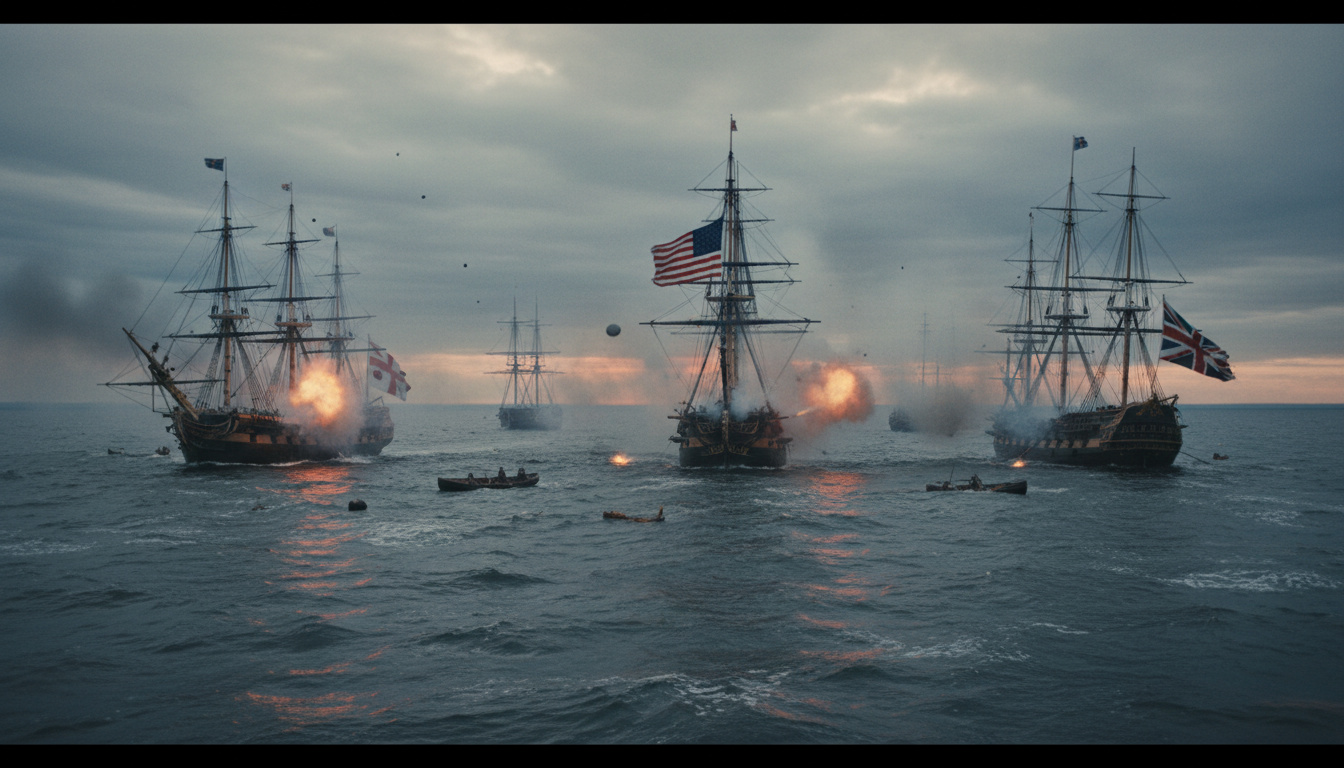

The War of 1812 stands as one of history’s most ambiguous conflicts, ending not with a decisive victory parade but with a military stalemate that left borders unchanged and historians debating its true legacy. Lasting from 1812 to 1815, this struggle between the United States and the British Empire produced no territorial gains for either side, instead cementing a draw formalized by the Treaty of Ghent.
Despite the absence of a clear winner on the battlefield, both nations emerged with conflicting narratives of success. The United States celebrated its survival against the world’s dominant naval power, while Britain claimed triumph in repelling American invasions of Canada. Yet beneath these claims lay a devastating toll, particularly for Native American tribes who lost British protection and faced accelerated dispossession of their lands.
Understanding who truly won requires examining not just the treaty terms, but the war’s causes, its brutal key battles, and its lasting impact on North American history.
Who Won the War of 1812?
- Stalemate, Not Victory: The conflict ended in a draw with no territorial exchanges, despite popular American narratives celebrating the “Second War of Independence.”
- Dual Claims: The U.S. claimed victory for defending sovereignty; Britain claimed victory for repelling Canadian invasions.
- Native American Catastrophe: Indigenous peoples suffered the greatest losses, losing British military support and facing accelerated land seizures.
- Timing Illusion: The American victory at New Orleans occurred after the peace treaty was signed, creating a false impression of decisive triumph.
- Economic Devastation: Both economies suffered—the U.S. under British naval blockade, Britain from American privateers capturing merchant vessels.
- National Identity: The war paradoxically strengthened American nationalism despite military mediocrity, sparking the “Era of Good Feelings.”
| Fact | Detail |
|---|---|
| War Declared | June 18, 1812 |
| Treaty of Ghent Signed | December 24, 1814 |
| Treaty Ratified | February 17, 1815 |
| Duration | 2 years, 8 months |
| US Combat Deaths | ~2,700 |
| Total US Deaths | ~10,000 (mostly disease) |
| British Losses at New Orleans | 2,037 casualties |
| Territory Exchanged | None |
| Pre-war Borders | Restored |
| Status | Status quo ante bellum |
What Was the Outcome of the War of 1812?
The War of 1812 concluded with a treaty that essentially returned North America to its pre-war condition. Signed in Ghent, Belgium, on December 24, 1814, and ratified by the United States on February 17, 1815, the Treaty of Ghent established a status quo ante bellum—restoring all boundaries to their positions before hostilities began.
Crucially, the document failed to address the original grievances that sparked the conflict. British impressment of American sailors and trade restrictions against France received no mention in the final terms. Prisoners were exchanged, but neither side gained concessions on maritime rights or territorial expansion.
Treaty of Ghent Terms
The treaty released all prisoners and restored conquered territories, but left unresolved the very issues of neutral shipping rights and impressment that had driven the United States to war. Follow-up agreements like the Rush-Bagot Treaty of 1817 demilitarized the Great Lakes, while the Convention of 1818 established clearer northern boundaries, but these came separately.
Why the War Ended
By late 1814, both sides faced exhaustion. Britain’s focus had shifted back to European affairs following Napoleon’s defeat, while the American economy strained under British naval blockades. The mutual recognition that neither could achieve decisive military goals led negotiators toward compromise rather than conquest.
News of the treaty reached North America too late to prevent the Battle of New Orleans, where Andrew Jackson achieved his famous victory two weeks after peace was technically established.
What Caused the War of 1812?
Multiple tensions converged to spark the conflict. Canadiens de Montréal and British colonial forces would soon face American troops, but the roots lay in maritime disputes and frontier expansionism.
Maritime Grievances
British impressment—the forced conscription of American sailors into the Royal Navy—angered the United States, with thousands allegedly seized between 1803 and 1812. Additionally, British Orders in Council restricted American trade with France during the Napoleonic Wars, crippling the U.S. economy.
Territorial and Frontier Tensions
American expansionists coveted Canada, believing Canadians would welcome liberation from British rule. Simultaneously, British support for Native American tribes resisting U.S. settlement—particularly Tecumseh’s Confederacy in the Northwest Territory—created friction on the western frontier. Indigenous leaders viewed British alliance as essential to checking American territorial aggression.
What Were the Key Battles and Events?
Fighting raged across multiple theaters, from the Canadian border to the Gulf of Mexico, involving regular armies, militia, privateers, and indigenous warriors.
The Northern Theater
American invasions of Canada failed repeatedly. General William Hull surrendered Detroit in August 1812 after a brief siege. British and Indigenous forces under Tecumseh secured victory at Queenston Heights in October 1812. The war turned partially in 1813 when Commodore Oliver Hazard Perry defeated the British on Lake Erie, allowing U.S. forces to secure the Thames River victory, though Tecumseh’s death there dissolved his confederacy.
Control of the Great Lakes proved decisive in the North. Perry’s victory at Lake Erie forced the British to retreat from Detroit and enabled the American occupation of York (modern Toronto), though the Canadians later repelled advances at Beaver Dams.
The Southern Theater and Creek War
In the South, the war intertwined with the Creek War. Andrew Jackson crushed the Red Stick Creeks at Horseshoe Bend in March 1814, securing vast territorial concessions through the Treaty of Fort Jackson. Later, Jackson’s forces repelled the British at New Orleans on January 8, 1815, inflicting 2,037 casualties while suffering only 71—a victory rendered strategically meaningless by the already-signed peace treaty.
The Battle of New Orleans resulted in over 2,000 British casualties versus approximately 70 American losses, yet occurred two weeks after diplomats signed the Treaty of Ghent, making it technically a battle fought after the war had legally ended.
Naval Engagements
At sea, the USS Constitution (“Old Ironsides”) defeated HMS Guerriere in 1812, boosting American morale against the legendary Royal Navy. American privateers captured approximately 1,344 British merchant ships, though Britain’s naval blockade of Eastern ports severely damaged the American economy.
Private vessels authorized by the U.S. government captured over 1,300 British merchant ships, disrupting trade and forcing Britain to divert naval resources, though this did not alter the war’s ultimate stalemate. For more information on the War of 1812, check out our Exèrcit dels Morts guia.
Timeline of the War of 1812
The conflict unfolded across three years of alternating fortunes:
- : United States declares war on Britain.
- : Hull surrenders Detroit; Fort Dearborn massacre occurs.
- : Americans capture and burn York (Toronto).
- : Perry’s victory on Lake Erie.
- : Battle of the Thames; Tecumseh killed.
- : Jackson wins at Horseshoe Bend.
- : British capture and burn Washington, D.C.
- : American victory at Plattsburgh halts northern invasion.
- : Baltimore defense inspires “The Star-Spangled Banner.”
- : Treaty of Ghent signed.
- : Battle of New Orleans.
- : Treaty ratified; war officially ends.
Was There a Clear Winner?
Historical consensus identifies the conflict as a military draw, though interpretation depends on which objectives one values.
| Established Facts | Points of Debate |
|---|---|
| No territory changed hands permanently | Whether psychological victory favors the U.S. for surviving |
| Prewar boundaries were fully restored | Whether Britain’s European commitments excuse the stalemate |
| Neither side achieved stated war aims | The extent to which New Orleans influenced public perception |
| The U.S. failed to conquer Canada | Whether Native American losses constitute a third “loser” category |
| Britain failed to establish buffer states in the Northwest | Whether the war truly ended Federalist relevance |
What Was the Lasting Impact of the War?
The war’s ambiguous resolution nonetheless reshaped North America. For the United States, the conflict fostered a surge of nationalism known as the “Era of Good Feelings,” destroyed the Federalist opposition, and launched Andrew Jackson toward the presidency. The military stalemate paradoxically encouraged westward expansion, as the destruction of Tecumseh’s confederacy removed barriers to settlement.
Canada emerged with a unified sense of identity forged through repelling American invasion, while Britain maintained its North American territories despite the distraction of European conflicts. Job Agency Near Me research suggests understanding such historical conflicts helps contextualize modern North American economic relationships, which evolved from these military boundaries into the peaceful trade partnerships seen today.
Native American tribes suffered the most catastrophic consequences. Losing British military protection after 1815, they faced accelerated removal and land seizures, with the Creek alone ceding over 20 million acres. The war effectively cleared the Old Northwest and Southeast for American settlement, paving the way for Manifest Destiny and the Monroe Doctrine of 1823.
What Do Historians Say About the War?
Historians widely view it as a draw, with both the United States and Britain claiming victories: the U.S. for defending its sovereignty against the world’s leading naval power, and Britain for repelling invasions of Canada.
Historical consensus cited by Wikipedia and the National Army Museum
The war boosted U.S. nationalism, ended Federalist opposition, and paved the way for Monroe Doctrine and Manifest Destiny.
Analysis from The Collector
What Is the Final Verdict?
The War of 1812 concluded without a victor in the traditional sense. The Treaty of Ghent restored pre-war boundaries while ignoring the maritime issues that caused the conflict. Both Britain and the United States claimed moral victories—Britain for defending Canada against invasion, America for surviving a second conflict with the empire. Yet the true losers were Native American nations, who lost crucial alliances and lands. The conflict’s legacy endures in the peaceful borders between the U.S. and Canada, and in the national myths that continue to obscure its status as a hard-fought, costly stalemate.
Why is the War of 1812 sometimes called “Mr. Madison’s War”?
Opponents of President James Madison named it thus to blame him for economic disruption and military failures, as he led the nation into the conflict against Federalist opposition.
Did the British burn down the White House?
Yes, in August 1814, British forces captured Washington, D.C., and burned the White House, Capitol, and other public buildings in retaliation for the American burning of York (Toronto).
How did the war affect Canada?
The war unified Canadian colonists against American invasion and fostered a distinct national identity separate from both the U.S. and Britain, despite the defense being largely conducted by British regulars.
Why did Native American tribes side with Britain?
Indigenous leaders like Tecumseh viewed British alliance as the only means to halt American territorial expansion, hoping a British victory would secure independent homelands in the Northwest Territory.
Was the Star-Spangled Banner written during this war?
Yes, Francis Scott Key wrote the poem that became the U.S. national anthem during the British bombardment of Fort McHenry in September 1814, after witnessing the American flag still flying at dawn.
Related stories




Jessica Morin covers provincial policy, regional economics and public affairs across Canada.