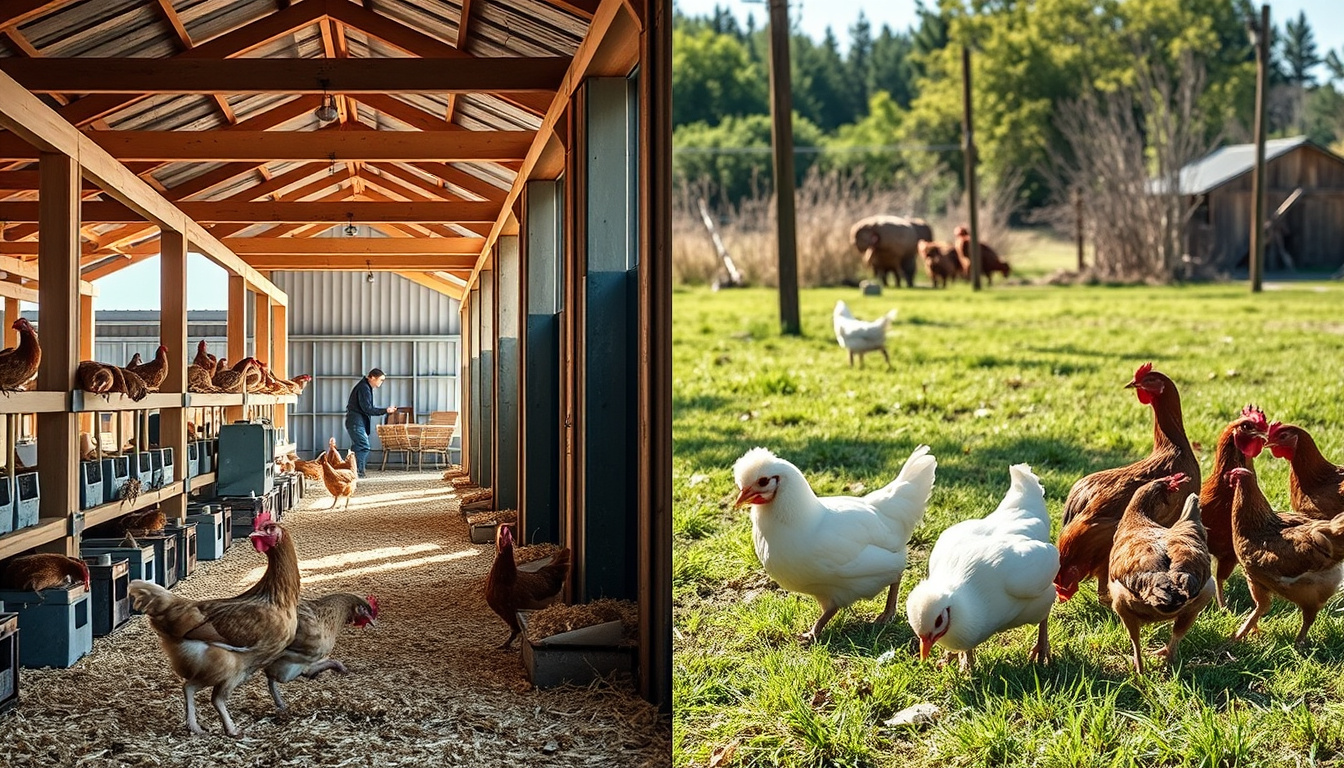

Walk through any grocery store’s egg aisle and you’ll face a dozen different labels — free-run, free-range, cage-free, organic. The difference between free-run and free-range eggs comes down to one simple thing: outdoor access.
Free-run eggs share of Canadian egg sales: Approximately 20% (Egg Farmers of Canada, 2023) ·
Free-range eggs share of Canadian egg sales: Approximately 5% (Egg Farmers of Canada, 2023) ·
Cage-free laying hens in the U.S. (2023): 38% of total flock (USDA) ·
Consumer willingness to pay premium for free-range: Up to 30% more vs. conventional (Consumer Reports, 2022)
Quick snapshot
- Free-run hens roam indoors without cages, no outdoor access (Eggs.ca (Canadian egg industry body))
- Free-range hens have access to the outdoors when weather permits (BCEgg (BC Egg Marketing Board))
- Both provide 6g protein per egg (Diet Redefined (nutrition blog))
- Optimal outdoor space per hen for welfare is still debated among researchers
- Long-term health benefits of free-range over free-run eggs are not conclusively proven
- Canadian shell-egg labelling rules being reviewed by CFIA as of 2024 (CFIA (federal regulator))
- Expect tighter enforcement on “free-range” claims as consumer confusion grows
Six key contrasts that capture the core differences between free-run and free-range eggs in Canada.
| Attribute | Free-run eggs | Free-range eggs |
|---|---|---|
| Housing | Indoors, cage-free barn | Barn plus outdoor access (≥120 days/year, ≥6 hrs/day per BCEgg (BC Egg Marketing Board)) |
| Outdoor requirement | None | Yes, during daylight when weather permits |
| Canadian regulation | No federal minimum; self-declared | Label claim must be truthful; no mandatory outdoor minimum under CFIA |
| Omega-3 difference | Baseline | May have up to 25% more omega-3 (Diet Redefined (nutrition blog)) |
| Price premium vs conventional | 10–20% higher | 30–50% higher |
| Welfare certification options | SPCA Certified, Certified Humane (if audited) | Same plus Animal Welfare Approved |
What’s the difference between free-run and free-range eggs?
Definition of free-run eggs
Free-run eggs come from hens that live inside a barn without cages. They can walk, spread their wings, and socialize, but they never go outdoors. The term is sometimes used interchangeably with “cage-free” in the United States, though in Canada Eggs.ca (the national egg industry association) defines free-run strictly as indoor, cage-free housing with no outdoor access.
Definition of free-range eggs
Free-range hens also live in a barn but have access to outdoor runs during daylight hours, at least 120 days per year and a minimum of six hours per day, per guidelines from BCEgg (British Columbia’s egg marketing board). The outdoor area may be a fenced pasture, a dirt lot, or a covered veranda — the key is that the hen can choose to go outside.
Canadian federal regulations (CFIA) require that any “free-range” claim be truthful, but they do not mandate a specific amount of outdoor space per hen. That means two cartons both labelled “free-range” could come from very different living conditions.
Key regulatory differences
- No federal law defines “free-run” — it’s an industry term. The CFIA (Canadian Food Inspection Agency) oversees all egg labelling for truthfulness, but specific production methods are not prescribed.
- Free-range claims must be supported; third-party certifications like SPCA Certified or Certified Humane add independent auditing.
- Grade A eggs are inspected for shell quality, air cell, and cleanliness regardless of housing type.
Bottom line: Free-run means indoor only; free-range means outdoor access. Canadian rules leave room for interpretation, so certification logos matter more than any single word on the carton.
Are free-range eggs actually better?
Nutritional differences: free-range vs. free-run
According to Eggs.ca, there are no significant differences in protein (6g per large egg), fat, or cholesterol between free-run and free-range eggs. However, some studies suggest free-range eggs may have slightly higher omega-3 fatty acids and vitamin D because hens forage on grass and insects. A nutrition blog analysis estimates a possible 25% increase in omega-3, though the evidence is not conclusive.
Welfare considerations
- Both systems eliminate battery cages, giving hens room to move.
- Free-range hens can exhibit natural behaviours like dust-bathing and foraging outdoors.
- But outdoor access brings risks: predation, disease exposure, and weather stress. A 2019 study in Poultry Science (peer-reviewed journal) found higher mortality in free-range flocks compared to indoor cage-free systems.
Environmental impact comparison
Free-range systems require more land per hen, which can lead to soil degradation if not managed with rotational grazing. Indoor cage-free operations use less acreage but rely on ventilation and lighting systems that consume energy. There is no clear winner — the trade-off is between animal welfare benefits and resource intensity.
Which type of egg is healthiest?
Free-range eggs and omega-3 content
As noted, free-range eggs may carry a modest omega-3 boost. But for a meaningful increase, consumers should look for “Omega-3 enriched” eggs — those are from hens fed flaxseed or fish oil, regardless of housing type.
Pasture-raised vs. free-range vs. free-run
- Pasture-raised: Hens spend most of their time outdoors on pasture. This system usually produces the best nutrient profile — a 2010 study from Mother Earth News (with Penn State verification) found pasture-raised eggs had 2x more omega-3, 3x more vitamin D, and 1/3 less cholesterol than conventional.
- Free-range: Outdoor access but may be limited.
- Free-run: Indoor only; no outdoor access.
Comparison of egg types by nutrient density
One pattern across all egg types: protein and most micronutrients are nearly identical. Organic eggs, however, showed a better omega-6:omega-3 ratio — 10:1 compared to 22:1 in conventional, according to 80/20 Nutrition (registered dietitian practice).
The implication: If you’re buying for nutrition alone, pasture-raised organic eggs are the top choice, but they cost significantly more. Conventional eggs remain a nutritious, affordable option.
Does free run mean free range?
No. Free-run does not mean free-range. The two terms describe different housing conditions, yet many consumers confuse them. A 2022 survey by the SPCA British Columbia (animal welfare organization) found that nearly 40% of shoppers incorrectly believed free-run eggs came from hens with outdoor access.
Why free-run is not free-range
The key distinction: free-run hens never see the outdoors. Free-range hens have the option to go outside. In marketing, “free-run” sounds similar to “free-range,” but the production reality is different.
Common labeling misconceptions
- “Free-run” is often used in Canada where U.S. labels would say “cage-free.”
- “Farm fresh” means eggs are graded on-farm and sold directly — nothing about housing.
- “Natural” can only be used in the context of “all eggs are natural,” per CFIA rules.
Consumer confusion in Canada
The SPCA BC survey underscores the problem: people are paying a premium for what they think is better welfare when the label “free-run” actually means indoor only. Clearer regulation and consumer education are needed.
What this means: Shoppers cannot rely on “free-run” as a welfare indicator — it guarantees no outdoor access, so the term misleads a significant portion of buyers.
What is the downside to free range chickens?
Predator risk and disease exposure
Free-range flocks have higher mortality. A 2019 meta-analysis in Poultry Science (peer-reviewed journal) reported that free-range hens face up to 5% higher death rates from predators, avian influenza, and parasites compared to indoor cage-free systems. Farmers must invest in fencing, predator control, and biosecurity.
Higher cost to producers and consumers
- Free-range eggs cost 30–50% more than conventional, and 15–20% more than free-run (Diet Redefined (nutrition blog)).
- Land costs, additional labour, and certification fees drive the price up.
Environmental challenges of outdoor raising
Outdoor runs concentrate manure, which can lead to nitrogen runoff and soil acidification if not rotated properly. Free-range operations also use more water for cleaning outdoor equipment than indoor barns.
Free-range hens gain quality-of-life benefits, but farmers assume higher mortality and operating costs — costs passed to the consumer.
Free-Run vs Free-Range vs Other Labels
Five common egg labels show one pattern: access to the outdoors is the dividing line, and each step toward more outdoor time increases cost and land use.
| Label | Outdoor access | Typical price vs conventional | Certification options |
|---|---|---|---|
| Conventional (caged) | No | Baseline | None |
| Free-run / Cage-free | No | +10–20% | Self-declared or SPCA |
| Free-range | Yes, ≥120 days/year | +30–50% | SPCA, Certified Humane |
| Pasture-raised | Yes, continuous | +50–100% | Animal Welfare Approved |
| Organic | Yes, plus organic feed | +60–100% | CFIA organic certification |
The pattern: as welfare standards increase, so does price — but consumers gain confidence through third-party audits.
Upsides of free-range eggs
- Hens can exhibit natural behaviours outdoors
- Slightly higher omega-3 possible
- Many consumers perceive better welfare
- Supports diversified farming systems
Downsides of free-range eggs
- 30–50% premium price
- Higher hen mortality from predators/disease
- Greater land use and environmental impact
- Inconsistent standards across producers
What we know — and what we don’t
Based on current evidence, here’s where the research is solid and where it’s still uncertain.
Confirmed facts
- Free-run hens are indoor-only; free-range hens have outdoor access.
- Both systems improve welfare over conventional cages.
- Protein, fat, and most nutrients are equivalent between free-run and free-range.
- Shell eggs in Canada are exempt from nutrition symbol labelling under certain conditions (CFIA).
What remains unclear
- The ideal outdoor space allowance per hen for optimal welfare is not scientifically settled.
- Whether free-range eggs provide meaningful long-term health benefits over free-run is not proven by current studies.
- Enforcement consistency of free-range claims across provinces varies.
What the experts say
“Free-run is not free-range. Free-run chickens live indoors without cages; free-range chickens have access to the outdoors.”
— Chicken Farmers of Canada (industry body), official definition
“Many consumers mistakenly believe free-run eggs come from hens with outdoor access. That’s a clear sign our labels need to be more transparent.”
— SPCA British Columbia (animal welfare organization), 2022 consumer survey
“There are no significant nutritional differences between free-run, free-range, and classic shell eggs in terms of protein or most nutrients. The choice is about welfare and price, not health.”
— Healthline nutrition editor (medical review platform)
What this means for Canadian shoppers
Free-run and free-range eggs both mark an improvement over caged systems. Free-range offers outdoor access and a marginal nutritional edge, but at a higher price and with environmental trade-offs. For shoppers in Canada, the decision comes down to budget and how strongly you value those outdoor-access benefits. If you can afford the premium, pasture-raised organic eggs offer the highest welfare and best nutrient profile. If budget is tighter, free-run remains a solid cage-free option. The clearest path is to look for third-party certification logos — SPCA, Certified Humane, or Animal Welfare Approved — rather than relying on packaging claims alone.
Shoppers who choose free-run over conventional pay a modest premium but get improved hen welfare, while those who opt for pasture-raised organic accept higher costs for the strongest welfare and nutritional guarantees.
Frequently asked questions
Are free-range eggs pasteurized?
Not necessarily. Pasteurized eggs are heat-treated to kill bacteria; this is separate from production method. Some free-range eggs may be pasteurized, but most shell eggs sold in Canada are not.
Can free-run eggs be organic?
Yes. Organic certification requires organic feed, no antibiotics, and specific space allowances — but does not mandate outdoor access. You can find organic free-run eggs.
What does pasture-raised mean?
Pasture-raised hens spend most of their lives outdoors on pasture. This system typically provides the most space per bird and allows natural foraging. It is not regulated by CFIA but is defined by certification programs like Animal Welfare Approved.
Do free-range chickens have better lives?
They have the opportunity to engage in natural outdoor behaviours, which improves welfare. However, they also face higher risks from predators, disease, and weather. The quality of life depends heavily on the specific farm’s management.
How to verify egg labeling claims?
Look for third-party certification seals on the carton: SPCA Certified, Certified Humane, Animal Welfare Approved, or Canada Organic. These require audits and defined standards.
Are brown eggs healthier than white eggs?
No. Shell colour depends on the breed of hen, not nutrition or production method. Brown and white eggs are nutritionally identical.
What is the most humane egg option?
Pasture-raised eggs from farms certified by Animal Welfare Approved or Certified Humane generally offer the highest welfare standards, as they combine outdoor access, ample space, and regular audits.
Related reading
- How to Cook Quinoa — General cooking and nutrition information
- 170 Celsius to Fahrenheit — Kitchen temperature conversions
Related stories





Hannah Walsh covers municipal government, councils, transit and local services across Canada.