
What is the Capital of British Columbia?
Victoria stands as the official capital city of British Columbia, a status it has maintained since 1868. As the seat of provincial government, Victoria houses the Legislative Assembly where elected representatives convene to pass laws affecting all residents of the province. The city’s position as capital predates British Columbia’s entry into Canadian Confederation in 1871, meaning Victoria’s governmental role was firmly established before the province joined the federation.
Victoria
British Columbia, Canada
Southern Vancouver Island
Vancouver (not capital)
Key Facts About Victoria as Capital
- Victoria became the capital through a formal proclamation by Governor Frederick Seymour on May 25, 1868
- The city was selected over New Westminster, the capital of the mainland Colony of British Columbia
- Victoria has retained capital status through Canadian Confederation in 1871 to the present day
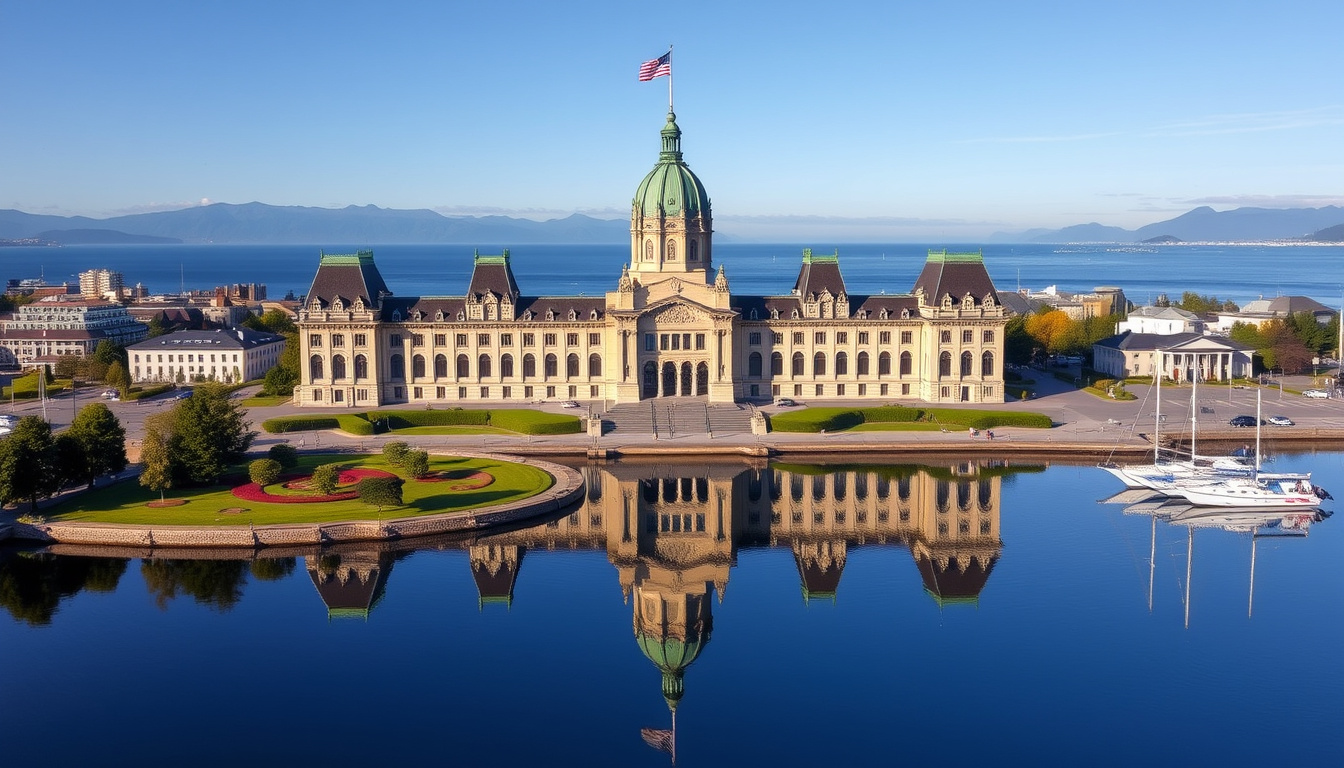
- The Legislative Assembly of British Columbia meets in the Parliament Buildings, completed in 1897
- The city’s position predates the establishment of the modern province of British Columbia
- Despite being the capital, Victoria is not the largest city in the province—Vancouver holds that distinction
Snapshot Facts
| Fact | Detail |
|---|---|
| Capital | Victoria |
| Date Established as Capital | May 25, 1868 |
| Island Location | Vancouver Island |
| Country | Canada |
| Provincial Legislature | Legislative Assembly of British Columbia |
| Parliament Buildings Completed | 1897 |
| Victoria City Population | 91,867 residents |
| Greater Victoria Population | 397,237 |
| Coordinates | 48°25′42″N 123°21′53″W |
| Confederation Year | 1871 |
Is Vancouver the Capital of British Columbia?
No, Vancouver is not the capital of British Columbia. This misconception persists because Vancouver is the province’s largest and most commercially prominent city, often overshadowing Victoria in international recognition. Vancouver’s rise to economic prominence came decades after Victoria had already established itself as the governmental center, following the Canadian Pacific Railway’s terminus arrival on Burrard Inlet in 1886.
Common Sources of Confusion
The confusion between Vancouver and Victoria stems from several factors. Vancouver’s metropolitan population of approximately 2.6 million people far exceeds Victoria’s metropolitan population of roughly 397,000, making Vancouver the undeniable economic powerhouse of the province. Internationally, Vancouver frequently appears in global media as a representative Canadian city, while Victoria remains relatively unknown beyond those familiar with Canadian geography.
Geographically, both cities occupy prominent positions in the public imagination, but they serve fundamentally different roles. Vancouver functions as the commercial, cultural, and economic hub of British Columbia, hosting major industries including film production, technology, shipping, and tourism. Victoria, by contrast, serves the governmental and administrative functions, though it maintains its own economic strengths in tourism, education, and public administration.
Victoria sits on Vancouver Island, separated from the mainland by the Strait of Georgia. Vancouver is located on the mainland coast of British Columbia. This geographic distinction is important because the capital’s island location was a key factor in its selection in 1868, offering defensibility advantages through the Esquimalt naval base that mainland locations lacked.
Vancouver vs. Victoria Comparison
The comparison between these two cities reveals a deliberate division of provincial functions. Vancouver handles the majority of international trade and commerce, processing goods flowing through the Port of Vancouver, Canada’s largest and most diversified port. Victoria concentrates governmental activities, hosting not only the legislative assembly but also numerous provincial government ministries and agencies.
For travelers and researchers alike, understanding this distinction matters practically. Those seeking government services, legislative information, or historical archives related to British Columbia’s provincial administration will find these resources centered in Victoria. Those seeking economic data, cultural attractions, or commercial opportunities more typically look to Vancouver. According to Wikipedia’s Victoria entry, Victoria was actually the capital of the Colony of Vancouver Island beginning in 1849, giving it a longer continuous experience with colonial governance than any mainland alternative.
Why is Victoria the Capital of BC?
Victoria became the capital of British Columbia through a combination of historical circumstances, strategic advantages, and colonial political dynamics. The decision emerged from the merger of the Colony of Vancouver Island and the Colony of British Columbia in 1866, which forced the question of where the united colony’s capital should be located. Governor Frederick Seymour allowed the Legislative Council to vote on this matter, with Victoria ultimately prevailing over New Westminster, the mainland colony’s existing capital.
Historical Factors in Victoria’s Selection
Several factors contributed to Victoria’s selection as the capital. Its size and commercial prominence following the 1858 gold rush made it the colony’s largest and most developed urban center. Victoria had grown from approximately 300 residents in the early 1850s to over 5,000 by the end of the gold rush decade, establishing a robust commercial infrastructure that could support governmental functions. According to Tally Ho Tours’ historical timeline, the city had developed as a boomtown supply port during the Fraser Canyon Gold Rush, gaining economic momentum that strengthened its candidacy.
Defensibility considerations also favored Victoria’s position. The presence of the Esquimalt naval base nearby provided maritime protection that the mainland candidate lacked. Victoria’s central location on the southern tip of Vancouver Island also offered strategic positioning relative to the broader Pacific region. Interestingly, Governor Seymour himself reportedly preferred New Westminster as the capital, but the Legislative Council’s vote ultimately reflected the commercial and practical advantages that Victoria offered.
Victoria’s Colonial Governance Heritage
Victoria’s path to capital status began decades before 1868. The Crown Colony of Vancouver Island was established in 1849, with Victoria designated as its capital from the colony’s inception. James Douglas, who had served as superintendent of the Hudson’s Bay Company’s Fort Victoria, became the colony’s governor and drove much of its early development. According to British Columbia History, this established governance precedent created institutional continuity that favored Victoria when the question of the united colony’s capital arose.
When the colonies merged in 1866, the governmental institutions already present in Victoria provided a ready-made administrative center. This institutional advantage proved decisive, as establishing a new capital elsewhere would have required significant investment in government infrastructure. Victoria’s existing role as capital of the Vancouver Island colony meant that legislative chambers, government offices, and administrative systems were already in place and functional. BC Black History documents that Governor Seymour formally proclaimed Victoria the capital on May 25, 1868, confirming the decision made through the earlier legislative process.
Victoria was founded in 1843 as Fort Victoria, a Hudson’s Bay Company trading post named after Queen Victoria. The land was originally called Camosun, meaning “rush of water” in the language of the Coast Salish Songhees people, who had established communities there long before European arrival.
Where is the Capital of British Columbia Located?
Victoria, the capital of British Columbia, is located on the southern tip of Vancouver Island, positioned off Canada’s Pacific coast across from the mainland portion of the province. The city’s precise coordinates are 48°25′42″N 123°21′53″W, placing it at the southeastern corner of the island where the Strait of Georgia meets the Pacific Ocean. This location positions Victoria as the gateway between Vancouver Island and the mainland, though travelers must take ferries or flights to cross the intervening waters.
Geographic Context and Surrounding Waters
The capital sits on the traditional territory of the Coast Salish Songhees people, whose ancestral lands encompassed the harbor area now known as Victoria’s inner harbor. The original Indigenous place name, Camosun or Camosack, referenced the rush of water through the harbor—a feature that made the location attractive for both Indigenous communities and later European trading operations. According to Wikipedia’s entry on Victoria, this geographic advantage positioned the future capital as an ideal trading post location when James Douglas selected the site for the Hudson’s Bay Company in 1843.
Vancouver Island itself is the large island that hosts Victoria, measuring approximately 460 kilometers in length and representing one of North America’s largest islands west of the Rocky Mountains. The island’s geography created natural boundaries that influenced the development patterns of British Columbia, with Victoria’s position at the southern tip giving it maritime access to both the Inside Passage and the open Pacific. This island location distinguishes the capital from Vancouver, which occupies the mainland coast approximately 100 kilometers to the northeast across the Strait of Georgia.
Relationship to British Columbia’s Mainland
The separation between Victoria and the mainland is a defining feature of British Columbia’s geography. While the province encompasses both island and mainland territories, the capital’s island location creates practical considerations for provincial administration. The distance between Victoria and major mainland centers requires ferry travel or flights for those connecting the capital with the province’s most populous regions. According to BC Geographical Names, this geographic relationship has been established since the colony’s earliest formation, when Vancouver Island and the mainland were administered as separate colonies before their eventual merger.
Accessing Victoria typically involves either air travel through Victoria International Airport, ferry service from mainland terminals including Tsawwassen and Nanaimo, or sea plane routes serving the inner harbor. The British Columbia ferry system connects Vancouver Island with the mainland at multiple points, with the Vancouver Island termini of Victoria and Nanaimo serving as primary connection points for residents and visitors traveling between the capital and the mainland portion of the province.
What is the Timeline of Victoria’s Capital Status?
Understanding the development of Victoria’s capital status requires examining the key events that shaped the colony’s governance and ultimately resulted in Victoria’s selection as the provincial capital. The following timeline traces the major milestones from Victoria’s founding through its establishment as the capital of modern British Columbia.
- 1843 — Fort Victoria established as a Hudson’s Bay Company trading post, named after Queen Victoria. James Douglas serves as superintendent.
- 1849 — Crown Colony of Vancouver Island created, with Victoria designated as its capital. James Douglas becomes the colony’s first governor.
- 1850–1854 — Douglas Treaties involve land purchases from Indigenous groups, though ethical controversies regarding these agreements persist among historians.
- 1858 — Fraser Canyon Gold Rush transforms Victoria into a boomtown supply port; population grows rapidly from 300 to over 5,000.
- 1862 — Smallpox epidemic devastates local First Nations communities, killing approximately two-thirds of Indigenous peoples in British Columbia.
- 1862 — Victoria incorporates as a city, solidifying its municipal status within the colony.
- 1866 — Colony of Vancouver Island merges with Colony of British Columbia (capital: New Westminster), forming the United Colony of British Columbia. Debates over the capital’s location begin.
- May 25, 1868 — Governor Frederick Seymour proclaims Victoria the capital of the united Colony of British Columbia.
- 1871 — British Columbia joins Canadian Confederation; Victoria retains capital status as the province’s seat of government.
- 1886 — Canadian Pacific Railway establishes terminus at Burrard Inlet, founding the city of Vancouver. Vancouver subsequently eclipses Victoria commercially.
- 1897 — Parliament Buildings completed, providing permanent facilities for the Legislative Assembly of British Columbia.
- 1904 — Butchart Gardens established, becoming one of Victoria’s most celebrated horticultural attractions.
- 1908 — Empress Hotel constructed, adding to Victoria’s legacy of grand heritage architecture.
The historical record surrounding the Douglas Treaties and colonial-era land acquisitions from Indigenous peoples involves ongoing ethical debates and reconciliation efforts. The 1862 smallpox epidemic and its disproportionate impact on Indigenous communities represents a dark chapter that continues to be addressed in historical scholarship and community remembrance.
What Facts Are Certain vs. Uncertain?
When examining British Columbia’s capital, distinguishing established facts from common misconceptions helps clarify the historical and geographic record. The following comparison identifies what is definitively known versus what involves ongoing confusion or limited available data.
| Established Information | Information That Remains Uncertain or Misunderstood |
|---|---|
| Victoria is the official capital of British Columbia, proclaimed on May 25, 1868 | The common assumption that Vancouver should be the capital due to its size represents a geographic misconception, not an administrative fact |
| The Legislative Assembly of British Columbia meets in Victoria’s Parliament Buildings | Some visitors assume the Parliament Buildings date from the 1868 capital decision; they were actually completed in 1897 |
| Victoria sits on Vancouver Island at coordinates 48°25′42″N 123°21′53″W | The precise population and economic rankings of Vancouver versus Victoria fluctuate; current census data should be consulted for exact figures |
| Victoria’s city population is 91,867 with Greater Victoria at 397,237 | While Victoria is the seventh most densely populated city in Canada, exact density rankings shift with population changes |
| British Columbia entered Canadian Confederation in 1871 with Victoria as capital | The specific details of debates within the Legislative Council during the 1868 capital decision involve limited surviving records |
| Governor Frederick Seymour proclaimed Victoria the capital despite reportedly preferring New Westminster | The degree to which personal preferences versus strategic considerations drove Seymour’s eventual acceptance remains a matter of historical interpretation |
What is the Geographic and Historical Context?
British Columbia occupies Canada’s westernmost province, bordered by the Pacific Ocean to the west, the American state of Alaska to the northwest, Alberta to the east, and the American states of Washington, Idaho, and Montana to the south. The province’s geography is distinguished by the Coast Mountains, the Interior Plateau, and extensive fjords along its mountainous coastline. Vancouver Island, where Victoria is located, represents the largest island on Canada’s west coast and forms a natural boundary between the mainland and the open Pacific.
The historical development of British Columbia followed a distinctive path compared to eastern Canadian provinces. Sparse Indigenous populations had established sophisticated societies across the region for thousands of years before European contact, with the Coast Salish peoples among those who developed complex trading networks and settlement patterns along the coast. European exploration accelerated in the late eighteenth century, with Spanish and British explorers mapping the coastline and establishing initial contacts with Indigenous communities. For more information, consult the Guia de conversió de dòlars canadencs a rúpies índies.
The Hudson’s Bay Company’s establishment of trading posts, beginning with Fort Langley in 1827, initiated the colonial period that would eventually lead to British Columbia’s formation as a British colony. The company’s influence extended across what is now the province, but the specific location of Fort Victoria at the southern tip of Vancouver Island positioned that future capital for its eventual administrative significance. According to BC Genesis, this early positioning under James Douglas created the foundation for Victoria’s subsequent selection as colonial capital.
Related provinces and territories provide additional geographic context. Alberta, which borders British Columbia to the east, has its capital at Edmonton, not Calgary, representing a similar situation where the largest city is not the administrative capital. Sainte Brigitte de Laval offers additional perspective on technological and cultural developments across Canadian communities, though this particular community’s relationship to the capital question requires separate geographic context. Understanding these relationships helps contextualize why British Columbia’s capital structure, with Victoria on Vancouver Island rather than the mainland’s largest city, follows patterns common across Canadian provinces.
What Do Sources Say About British Columbia’s Capital?
Multiple authoritative sources confirm Victoria’s status as British Columbia’s capital and provide details about the historical circumstances surrounding this designation. Official and encyclopedic sources establish the factual basis for understanding the capital’s location, history, and significance.
“Victoria was selected over New Westminster as the capital of the united Colony of British Columbia. On May 25, 1868, Governor Frederick Seymour proclaimed Victoria the capital.”
“The Crown Colony of Vancouver Island was created in 1849, with Victoria as its capital; James Douglas, the fort’s superintendent, became governor and drove early development. Victoria retained this status when British Columbia joined Canadian Confederation as a province in 1871.”
“Gold discoveries on the mainland in 1858 transformed Victoria into a boomtown supply port, growing its population from 300 to over 5,000 rapidly. Facing declining gold rush revenues and debt by 1866, the Colony of Vancouver Island merged with the mainland Colony of British Columbia.”
These sources collectively establish that Victoria’s capital status resulted from deliberate colonial governance decisions rather than organic demographic patterns. The governmental functions concentrated in Victoria reflect nineteenth-century political dynamics, where defensibility considerations, existing infrastructure, and legislative compromise combined to produce a specific outcome. The Legislative Assembly of British Columbia’s official resources reinforce this historical narrative through their documentation of the 1868 proclamation and its aftermath.
The government’s own historical materials emphasize that Victoria’s selection followed established precedent from the Colony of Vancouver Island era, combined with practical considerations about the city’s commercial development and strategic position. The City of Victoria’s official website describes the community’s heritage and character, providing contemporary context for understanding the capital city’s evolution from colonial administrative center to modern provincial capital.
What to Know About British Columbia’s Capital
Victoria’s status as the capital of British Columbia represents a well-established historical fact confirmed by government sources, encyclopedic references, and official colonial records. The city has held this designation since 1868, predating the province’s entry into Canadian Confederation and continuing through the present day. Understanding this distinction matters for anyone studying Canadian geography, provincial governance, or the historical development of British Columbia as a province.
The choice of Victoria over alternatives like New Westminster or Vancouver reflects the specific circumstances of mid-nineteenth-century colonial governance, where factors including existing infrastructure, commercial development, and strategic defensibility influenced legislative decisions. Vancouver’s subsequent rise as the province’s commercial hub occurred decades after Victoria’s capital status was already secured, meaning the two cities developed complementary rather than competing roles within the provincial structure.
For further exploration of Canadian historical and political topics, Who Won the War of 1812 provides additional context on military and diplomatic history that shaped Canada’s development as a nation, offering parallel understanding of how specific events and decisions established frameworks that continue to influence Canadian institutions today.
Frequently Asked Questions
What is the capital city of British Columbia?
Victoria is the capital city of British Columbia. It has held this designation since May 25, 1868, when Governor Frederick Seymour formally proclaimed it the capital of the united Colony of British Columbia.
Is Vancouver the capital of British Columbia?
No, Vancouver is not the capital of British Columbia. While Vancouver is the province’s largest and most commercially prominent city, Victoria serves as the capital, housing the Legislative Assembly and provincial government ministries.
Why is Victoria the capital of British Columbia and not Vancouver?
Victoria was selected as the capital in 1868 due to its larger population, established commercial infrastructure following the 1858 gold rush, defensibility advantages through the nearby Esquimalt naval base, and existing status as capital of the Colony of Vancouver Island since 1849. Vancouver’s rise came later with the Canadian Pacific Railway in 1886.
Where is Victoria located?
Victoria is located on the southern tip of Vancouver Island at coordinates 48°25′42″N 123°21′53″W. The city sits off Canada’s Pacific coast, across the Strait of Georgia from British Columbia’s mainland.
What is the population of British Columbia?
British Columbia is Canada’s third-largest province by population with approximately 5.4 million residents. Victoria, the capital city, has approximately 91,867 residents within city limits and 397,237 in the Greater Victoria area.
What is the capital of Alberta?
Edmonton is the capital of Alberta. Like Victoria in British Columbia, Edmonton is not the province’s largest city—Calgary holds that distinction—demonstrating a pattern common across Canadian provinces where the administrative capital differs from the largest urban center.
When were the Parliament Buildings in Victoria completed?
The Parliament Buildings in Victoria were completed in 1897, housing the Legislative Assembly of British Columbia. The elegant neo-baroque structure overlooks the inner harbor and serves as the primary symbol of Victoria’s role as provincial capital.
When did British Columbia join Canadian Confederation?
British Columbia joined Canadian Confederation in 1871, three years after Victoria was proclaimed the capital of the united colony. Victoria has remained the provincial capital continuously since the 1868 proclamation.
Related stories





Hannah Walsh covers municipal government, councils, transit and local services across Canada.