
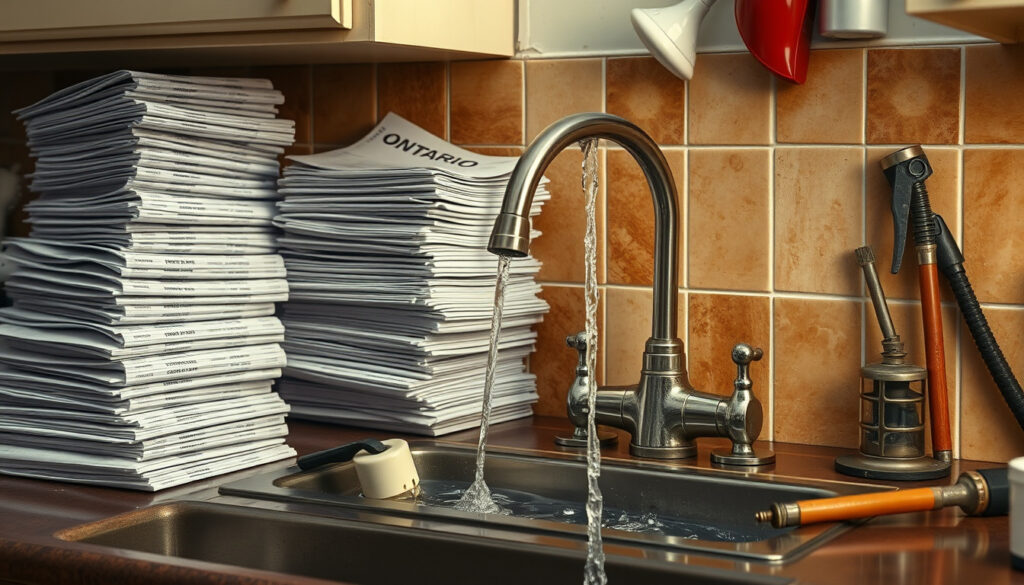
When Vipin Sehgal opened his Scarborough water bill in early 2018, he found $2,500 waiting for him—more than five months of normal usage compressed into a single invoice. A small leak in his toilet tank was silently running up charges that, as Toronto Water explained, could easily reach $2,000 per month in worst-case scenarios. For Ontario homeowners still unaware of how much damage an undetected leak can do, cases like Sehgal’s serve as a cautionary tale that the cause of a shocking bill is often closer to home than they think.
Bills for two Ontario homeowners: nearly $20,000 combined · Common cause cited: leaky toilets · Adjustment option: available via Toronto.ca
Quick snapshot
- Leaky toilets caused $2,500–$17,000+ bills for Ontario homeowners (Toronto CityNews)
- Toronto Water charges based on meter readings regardless of when repairs happen (Toronto CityNews)
- A leaking 6-litre toilet tank can add roughly $2,000 per month to bills (Toronto CityNews)
- Exact dates for all recent CTV News-reported cases
- Official Toronto Water statistics on billing adjustment requests
- Whether recent provincial regulations address high-bill disputes
- May 14, 2018: CityNews publishes Scarborough case investigation (Toronto CityNews)
- Recent: CTV News reports multiple Ontario homeowners facing $8,000–$17,000+ bills (CTV News)
- Homeowners who spot unexpected spikes can request meter testing through Toronto Water
- Bill adjustments under “unexplained consumption” provisions may apply only when no leak is identified
These figures represent the documented range of bills reported across Ontario municipalities, with individual cases varying by consumption volume and billing period.
| Detail | Value |
|---|---|
| Reported high bills | $25,028 total for two homes (CTV News) |
| Cause in cases | Leaky toilets |
| Single Scarborough case | $2,500 for 1,572 cubic metres over five months |
| Leak math | 6-litre tank filling in 30 sec = ~$2,000/month |
| Adjustment source | Toronto.ca utility bill page |
Why is my water bill so high in Ontario?
Ontario homeowners who open a utility bill far higher than expected often find an unwelcome explanation waiting inside their own bathroom. Leaky toilets—particularly in underused guest bathrooms or rarely occupied homes—regularly emerge as the culprit behind bills that can climb into thousands of dollars.
Recent homeowner cases
In one well-documented Scarborough case, Vipin Sehgal received a $2,500 water bill for 1,572 cubic metres of water over five months ending in February 2018. Toronto Water investigated and found a small leak in his toilet tank, attributing the spike directly to that source. The same volume of water—enough to fill five average-sized swimming pools—represents a level of waste most homeowners never imagine when they hear a faint hiss from a distant bathroom.
Toronto Water charges based solely on what passes through the meter. Repairs made after the billing period do not automatically trigger refunds. The utility’s position, as explained by a spokesperson, is straightforward: “We can only charge by what goes through the meter. Whatever goes through there, that’s what we’re going to charge.”
Leaky toilets in Ontario
CTV News has reported multiple cases across Ontario where homeowners faced bills ranging from $8,129 to over $17,000—all attributed to leaky toilets. A Pickering resident in Durham Region received a bill exceeding $11,000 under similar circumstances. The pattern is consistent across regions: an undetected leak, a surprise bill, and a utility that expects full payment regardless of when the problem was finally identified and fixed.
“If you think of a toilet, most tanks are about six litres in volume, so after you flush, say it takes 30 seconds to fill, that’s 12 litres a minute, over a day that’s $66 a day. In a month, that’s about $2,000 a month. It’s very easy for it to add up.”
— Casale, Toronto Water representative (Toronto CityNews)
What is the most common reason for a high water bill?
Continuously running toilets consistently rank as the single most common source of unexpectedly high water bills for Ontario homeowners. Unlike visible leaks from a dripping faucet, toilet leaks often go unnoticed because the water flows directly into the bowl and the sound can be mistaken for a brief fill cycle.
Leaky toilets
- The flapper valve — The rubber flapper inside the tank can degrade over time, failing to seal properly and allowing water to continuously flow from tank to bowl.
- The fill valve — A malfunctioning fill valve may not shut off correctly, causing water to overflow through the overflow tube.
- Phantom flushing — A slow leak from the tank to the bowl can repeat every few minutes, silently wasting water around the clock.
Leaks in underused bathrooms often go undetected for months because homeowners rarely visit those spaces daily. A guest bathroom or basement toilet used only occasionally can run continuously for weeks before anyone notices.
High usage appliances
Beyond toilet leaks, certain appliances and household patterns can drive up consumption significantly:
- Leaking washing machine hoses or failed pump seals
- Irrigation system leaks, particularly in spring and fall when systems are tested or winterized
- Hot tub refills or swimming pool water level maintenance
- Extended irrigation during dry periods, especially in areas with tiered pricing
What is the average monthly water bill in Ontario?
Pinpointing an exact average for Ontario water bills is complicated by the variety of municipal and regional providers across the province. Toronto, for example, charges based on consumption and fixed service fees, while Durham Region (which handles Pickering) operates under its own rate structure.
Utility bill averages
Based on available data from municipal utilities and the limited publicly reported cases, a typical Ontario household with reasonable water use might expect monthly bills in the $50–$120 range for average consumption. However, any unexpected leak can multiply that figure several times over within a single billing cycle.
Comparisons for households
The starkest comparison comes from the documented cases themselves. Sehgal’s Scarborough bill of $2,500 covered five months of usage that normal households would account for over a year or more. A Pickering resident faced a single bill exceeding $11,000, while other homeowners reported total charges over $17,000 spread across multiple billing periods. Each of these cases involved a leak that went undetected for an extended period—sometimes weeks or months—before the household noticed and arranged repairs.
How can I reduce my water bill in Ontario?
Whether you’re facing an unexpected spike or simply want to keep future bills predictable, a combination of proactive detection and usage management can make a measurable difference.
Fix leaks
The most impactful step is identifying and repairing any leaks before they run up charges. The dye test remains the simplest and most reliable method for toilet leaks:
- Place a few drops of food colouring or an unflavored tea bag in the tank
- Wait 10–15 minutes without flushing
- If colour appears in the bowl, the flapper or valve is leaking
Listen for running water sounds from bathrooms you don’t use daily. Even a faint, intermittent noise can indicate a slow leak that might be adding hundreds of dollars to your next bill.
Usage tips
- Check your utility’s online portal—Toronto’s “My Water Toronto” allows customers to monitor daily, weekly, and monthly consumption patterns and spot anomalies early
- Run full loads in dishwashers and washing machines rather than partial loads
- Fix dripping faucets promptly; a single dripping faucet can waste significant water over time
- Consider low-flow showerheads and faucet aerators in high-usage bathrooms
The math from Toronto Water shows exactly how quickly small leaks translate to large bills. A six-litre tank refilling every 30 seconds adds roughly $66 per day—or about $2,000 per month. For a household that normally pays $80 per month, a single undetected leaky toilet can produce a bill 25 times higher than usual before anyone realizes what is happening.
“One way to determine if a toilet is leaking is to listen. You can usually hear it leaking. If not, you can usually do a little dye test with food colouring or a tea bag, wait about 10 to 15 minutes, and if colour appears in the bowl, you have a leak.”
— Casale, Toronto Water representative (Toronto CityNews)
What uses up the most water in a house?
Understanding where water consumption concentrates in a typical household helps homeowners prioritize detection efforts and identify which appliances deserve regular attention.
Top indoor uses
- Toilet flushing — The largest indoor water use for most households, accounting for roughly 30% of daily indoor consumption
- Showering and bathing — A ten-minute shower with a standard showerhead can use 60–80 litres of water
- Laundry — A full washing machine load can require 40–60 litres depending on the model and settings
- Kitchen use — Dishwashing and cooking account for a smaller but still significant portion of household consumption
Shower water volume
A standard showerhead flows at approximately 9.5 litres per minute. A ten-minute shower therefore uses roughly 95 litres of water. For households with multiple occupants showering daily, this single activity can account for several hundred litres of consumption per week—making it the second-largest driver of monthly bills after toilet flushing.
When a leaky toilet runs continuously, it consumes far more water than any combination of showers and laundry. A defect that adds even one extra litre per minute over a 30-day period translates to over 40,000 litres of unnecessary consumption—a volume that can easily appear as a bill several times the normal amount.
How to dispute a high water bill in Ontario
If you receive a bill that seems far outside your normal range, Ontario’s municipal utilities typically offer pathways to request investigation and potential adjustment, though the outcome depends on the cause of the spike.
Steps to request meter testing and bill review
- Document your usage patterns — Note the billing dates after any changes or repairs to plumbing in your home, as utilities often compare current usage to historical baselines
- Check for leaks yourself — Perform the dye test on all toilets, listen for sounds in infrequently used bathrooms, and inspect visible pipe connections for drips or moisture
- Contact your utility provider — In Toronto, the utility bill adjustment page at Toronto.ca allows customers to request reviews; a spokesperson confirmed that meter accuracy can be verified and extra fees reversed if the meter is found to be faulty
- Request meter testing — If you believe your meter may be malfunctioning rather than accurately recording consumption, most utilities will test the device upon request
- Review the “unexplained consumption” provision — Toronto’s bylaws include a provision for adjustments when consumption spikes have no identified cause, though this does not apply when a leak is discovered
Timeline
- : Vipin Sehgal receives $2,500 water bill for five months of usage
- : Toronto Water investigates and confirms toilet leak, plumber finds smaller ongoing leak a month later
- : CityNews publishes detailed Scarborough case investigation
- : CTV News reports multiple Ontario homeowners facing $8,000–$17,000+ bills from leaky toilets
What we know and what remains unclear
Confirmed
- Leaky toilets caused bills of $2,500–$17,000+ for documented Ontario cases
- Toronto Water bills based solely on meter readings regardless of post-period repairs
- Small leaks in rarely used bathrooms frequently go undetected for months
- No automatic adjustment when a leak is identified and repaired after billing
Unclear
- Exact dates for CTV News’s most recent cases
- Whether recent provincial regulations have changed billing dispute outcomes
- Aggregate data on how many adjustment requests Toronto Water receives annually
“City staff determined the water meter continues to provide accurate readings. We hypothesized the homeowner was experiencing a leak.”
— City of Toronto spokesperson (CTV News)
Summary
Ontario homeowners who have received shockingly high water bills in recent years have typically discovered a familiar culprit: an undetected leak, most often in a toilet. Cases documented from Scarborough to Pickering show bills ranging from $2,500 to over $17,000, with Toronto Water confirming that a single leaky toilet can generate approximately $2,000 in monthly charges depending on the tank size and fill rate. The utility bills based on meter readings, meaning that repairs made after the billing period do not automatically cancel accumulated charges. For homeowners, the practical takeaway is clear: checking toilets now, before the next billing cycle runs, is far less expensive than waiting to discover a leak through an invoice that bears little resemblance to your normal usage.
Related reading: Ontario high-stakes lottery win
Ontario homeowners facing steep bills from leaky toilets should inspect irrigation systems too, where sprinkler repair fixes prevent similar water waste and unexpected charges.
Frequently asked questions
How do I check for a leaky toilet?
Place a few drops of food colouring or an unflavored tea bag in the tank. Wait 10–15 minutes without flushing. If colour appears in the bowl, your flapper or fill valve is leaking and needs replacement.
What should I do if my Toronto water bill is higher than expected?
Contact Toronto Water through their utility bill page on Toronto.ca. You can request meter testing if you believe the device is malfunctioning, and you may qualify for an adjustment if the spike qualifies as “unexplained consumption”—though this provision does not apply when a leak is identified.
Can I get a refund if my high bill was caused by a leak?
Toronto Water bills based solely on meter readings and does not automatically reverse charges after a leak is repaired. If the meter is found faulty, any excess fees will be reversed. Adjustments under the “unexplained consumption” provision apply only when no leak cause is identified.
Where can I monitor my water usage online?
Toronto residents can use the “My Water Toronto” portal to check daily, weekly, and monthly consumption patterns. Comparing these figures regularly can help you spot anomalies before they become expensive surprises.
How much water does a leaky toilet actually waste?
A standard six-litre toilet tank refilling every 30 seconds wastes approximately 12 litres per minute, which translates to roughly $66 per day or about $2,000 per month in water charges at typical Ontario rates.
What appliances cause the highest water consumption?
Toilet flushing is the largest indoor use, followed by showers, laundry, and kitchen activities. A single running toilet leak typically uses far more water than all other indoor activities combined, which is why leak detection should be the first priority for any homeowner trying to reduce their bill.
Does Durham Region handle water billing the same way as Toronto?
Durham Region handles its own water billing separately from Toronto, but similar issues have been reported, including bills exceeding $11,000 for Pickering residents under comparable circumstances. The regional utility expects full payment, with leak investigation following similar procedures.
Related stories





Hannah Walsh covers municipal government, councils, transit and local services across Canada.